Market & Commercial Opportunity
The U.S. Camera Stabiliser and Slider Market
Market size, product segments, buyer channels, competition, trends, manufacturing, compliance and the commercial opportunity in U.S. camera sliders and motion-control rails.
Published November 10, 2026
Executive summary
Camera stabilisation is a large and growing equipment category, but the rail-based part of it is a specialist slice sold to people who make video for a living. Public estimates put the global camera stabiliser market at USD 4.76 billion in 2024, forecast to reach USD 7.21 billion by 2033 at about 4.7% a year, with smartphone applications the fastest-growing use; a second estimate starts from the same figure and reaches USD 6.45 billion by 2030 at 5.19%; a third puts the market at USD 4.7 billion in 2024, the U.S. at about USD 1.3 billion, and the handheld sub-segment at USD 3.3 billion by 2030. [F1] [F2] [F3] The three figures overlap and are not additive.
The segment named in public summaries includes DJI, Zhiyun, Moza, FeiyuTech, Freefly Systems, Glidecam, ikan, Pilotfly and Hohem, which together cover handheld gimbals, stabilised heads, rail systems and cinema motion control. Public abstracts redact revenue and do not rank the companies. [F4]
The buyer that fits a rail is produced video: product shots, tabletop food and craft content, interviews and small-studio work where a camera has to repeat a move. That buyer already spends on gimbals, sliders and lights, and cares about setup time more than raw payload. [F1] [F3]
No public source in this review isolates rail sliders, motorised pan-tilts or wind-stabilising wings, and the summaries do not give prices by payload class, so the specialist slice cannot be sized from public data.
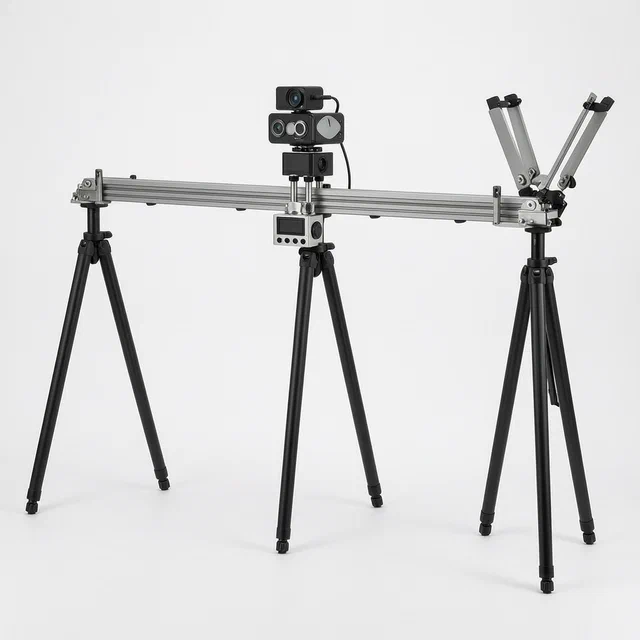
One patent on this site relates to a product sold in this market, a mobile camera platform on an adjustable guide rail. It is listed at the end of this report; the market analysis below is separate from its structure.
1. Market size and growth
Global camera stabilisers. USD 4.76 billion in 2024, forecast to reach USD 7.21 billion by 2033 at about 4.7% a year, with smartphone applications the fastest-growing use. [F1]
Second estimate. Same 2024 base, reaching USD 6.45 billion by 2030 at 5.19% a year. It differs from the first in horizon and growth rate, not in base. [F2]
United States and handheld. A third estimate puts the market at USD 4.7 billion in 2024, the U.S. at about USD 1.3 billion, and the handheld sub-segment at USD 3.3 billion by 2030. [F3]
Rail and motion-control sliders. No public source in this review reports them separately. [F1] [F3] [F4]
IP2M estimate. Based on the U.S. share of the global figure, an illustrative 5% share of the U.S. market would imply roughly USD 65 million in 2024. It overstates the opportunity, because the product here is a rail-based motion system rather than a handheld gimbal, and rails are a specialist slice. [F1] [F3]
2. Product segments and who buys
| Segment | Typical product forms | Buyer and channel | What decides the purchase |
|---|---|---|---|
| Handheld gimbal | Three-axis stabiliser for phone or camera | Creators and videographers through e-commerce and camera retail | Payload, battery, balance time, price |
| Rail slider | Manual or motorised rail with a carriage | Producers and studios through camera dealers | Smoothness, length, setup time, payload |
| Motorised motion control | Pan-tilt head, programmable moves, repeatability | Small studios and product shooters | Repeatability, software, rig stiffness |
| Tabletop and overhead rig | Short rail, overhead arm, folding base | Product, food and craft shooters | Footprint, packability, quick setup |
| Rental and house rigs | Larger systems rented per shoot | Production houses through rental houses | Reliability, support, availability |
The published figures cover camera stabilisers as a category, not these rows. [F1] [F3] [F4]
The tabletop and overhead row is where a folding, repeatable rail fits. A producer shooting product or food needs the same move twice — for a second take, a product variant or a client revision — and needs to pack the rig between shoots. That is a different buyer from the handheld creator, who buys one device that fits in a bag and never sets up a rail at all. [F1] [F3]
3. Competitive landscape
DJI, Zhiyun, Moza, FeiyuTech, Freefly Systems, Glidecam, ikan, Pilotfly and Hohem appear in the category, covering handheld gimbals, stabilised heads, rail systems and cinema motion control. The public abstract redacts revenue figures and does not rank them. [F4]
The structure is brand-led at the handheld end and specialist at the rail end. Gimbal brands compete on payload, battery and software; rail and motion-control makers compete on repeatability, stiffness and the reliability a rental house will accept. A new rail platform therefore does not have to beat DJI at its own product; it has to be credible to the shooters and dealers who already buy rails. That is a smaller, more technical sale, and it is where a mechanism advantage counts. [F3] [F4]
4. Trends and innovation opportunities
Trends
Smartphone use as the fastest-growing application. Smartphone applications are the fastest-growing use of stabilisers, which supports handheld volume more than rail volume. [F1]
Online as the fastest-growing channel. Online is the fastest-growing sales channel, which favours products that demonstrate in video and ship in a small box. [F2]
Produced content at small scale. Product, food and craft content is made by small teams that buy their own rigs rather than renting, which creates demand for portable motion control. This is a reading of the buyer group, not a measured trend in the sources. [F3]
Setup time as a specification. As more shoots are one-person, the time to level and pack a rig becomes a buying criterion alongside smoothness. [F4]
Innovation opportunities
The opportunities below are an analyst reading of the segment structure, not a sourced forecast.
- A base that folds and still holds rigid. Folding wings make a rail packable, but a base that flexes shows up as vibration in the footage. What to prove: stiffness and vibration at the folded-joint, measured against a fixed base, and that the joint does not loosen after repeated setups.
- Repeatable end stops without switches. Magnetic sensor sheets give positions that do not depend on a mechanical switch being hit. What to prove: repeatability of the stop position after many passes and after the rig has been folded and rebuilt.
- Quick release that survives a day of moving. A release that couples the camera side to the rail saves time at every reposition. What to prove: the lock holds under payload and motion, and it does not introduce play at the joint.
- Weight without losing stiffness. A rack and rail that keep the rig light for its payload class. What to prove: deflection under the rated payload at full extension, and a weight that keeps the whole system in one case.
5. Manufacturing and supply chain
A rail platform is a precision mechanical assembly. The rail is extruded or machined aluminium with a belt or lead screw; the carriage rides on bearings; the base is machined aluminium with folding wings on hinges; the pan-tilt head is a cast or machined housing with motors, gears and encoders; the electronics are a controller board with a radio link and a battery.
Processes. Extrusion and machining, anodising, bearing and carriage assembly, gear and motor assembly, board assembly, calibration, motion testing and packaging. A folding base adds hinge machining and a repeatability check after folding, which is a test step a fixed base does not need.
Tooling. Extrusion dies, machining fixtures and moulds for housings carry the tooling cost, with castings for larger heads. A folding base is mostly a machining and hinge-design change, which is cheaper to tool than a new extrusion but harder to make rigid.
Cost drivers. Aluminium volume and machining time, bearings and rail grade, motors and encoders, controller board, battery and case. In this category the customer compares systems by payload and price per kilogram, so extra mass that does not add payload is a direct competitive loss.
Quality and testing. Buyers test payload deflection, vibration and smoothness, repeatability, motor noise, battery runtime and case durability. A folding platform should be tested for stiffness both before and after repeated fold-and-rebuild cycles, because that is the failure a portable rig actually has.
No public source in this review breaks down component cost or lead time for camera sliders. The manufacturing paragraphs above are manufacturing judgment, to be replaced with supplier quotes before a commercial commitment.
6. Compliance and market entry
FCC Part 15 applies to the wireless control link and the digital electronics, UN 38.3 testing applies to any lithium battery shipped with the product or its case, and California Proposition 65 warnings may be needed for coatings, plastics and solder. [F5] [F6] [F7]
This review did not identify a product-specific mandatory federal performance standard for camera sliders or motion-control rigs beyond those electrical and battery rules. That is a finding of absence in this review, not a legal conclusion that no standard exists; rental-house requirements, insurer conditions and voluntary standards can still add scope. [F5] [F6]
The public record shows no U.S. family member for the patent linked to this report. That is an opening rather than a clearance: separate U.S. patents on folding rail bases, magnetic end stops and quick-release mounts may still apply, and a freedom-to-operate review is required before launch.
For a U.S. launch, the practical sequence is: run electrical and radio testing; test any battery and the finished device for transport; measure stiffness, vibration, repeatability and payload deflection; cycle the fold and the quick release; review materials against Proposition 65; and keep the records with the product file. A camera-accessory dealer or a motion-control brand already selling into the channel usually owns this process.
7. Commercial paths, risks and open questions
Path 1: OEM for a motion-control or camera-accessory brand. The brand brings the dealer network, the software and support; IP2M supplies the rail, base and quick-release mechanism. This is the realistic route into a technical, dealer-led category.
Path 2: rental-house and studio channel. A rig that a rental house will stock has passed a different test: reliability under repeated use by strangers. A first batch placed with one rental house is a credible proof point.
Path 3: prosumer listing with a folding claim. A portable rig sold online competes on video and reviews, where the fold and the setup time are easy to show.
Risks. Stiffness loss at a folding joint, sensor drift after folding, quick-release play, motor noise, battery and radio certification, and price comparison against handheld gimbals that need no rail are the recurring risks. In this category a rig that shows vibration has failed at the one thing it exists to do.
Open questions. The public record does not give U.S. volume for rail sliders or motorised rigs, their price by payload class, or stiffness and repeatability data for the mechanism described on the linked patent page. The grade for any single product would improve with a dealer or studio pilot and measured stiffness, repeatability and fold-cycle data, and would fall if the folding base shows vibration, if sensor alignment drifts after repeated folding, or if an FTO review finds blocking U.S. claims.
Sources
- [F1] Straits Research, Camera Stabilizer Market Size, Share, and Trends Analysis 2032, public summary, 2025 (2024 data).
- [F2] TechSci Research via Global Information, Camera Stabilizer Market – Global Industry Size, Share, Trends, Opportunity, and Forecast 2020–2030F, 2025.
- [F3] Global Industry Analysts via Global Information, Camera Stabilizers – Global Market Trajectory and Analytics, 2024 (U.S. and handheld figures).
- [F4] QYResearch, Camera Gimbal Stabilizer – Global Market Share and Ranking, Overall Sales and Demand Forecast 2024–2030, 2024 (company landscape).
- [F5] eCFR, 47 CFR Part 15, current.
- [F6] United Nations Economic Commission for Europe, UN Manual of Tests and Criteria, Section 38.3, current.
- [F7] California Office of the Attorney General, California Proposition 65, current.
Related patent categories
Related patents
Product pages for patents that fit this market. Each page covers the mechanism, use cases, customization and patent status.