Market & Commercial Opportunity
The U.S. Automotive Seat Belt Buckle Market
Market size, supply chain, competitors, trends, manufacturing, compliance and the commercial opportunity in U.S. automotive seat belt buckles and buckle covers.
Published November 10, 2026
Executive summary
The seat belt buckle is a small, certified component inside one of the most regulated assemblies in a vehicle. Public estimates put the global automotive seat-belt system market at about USD 19.9 billion in 2025, forecast to reach USD 24.6 billion by 2032 at roughly 3.1% a year; a narrower seat-belt product measure puts the 2024 market at about USD 2.8 billion. Component reports split the market into adjustors, buckles, retractors and webbing but keep the buckle value behind a paywall. [F1] [F2] [F3]
The buyer is a vehicle programme, not a consumer. Autoliv, Joyson Safety Systems, ZF, Yanfeng and Toyoda Gosei lead the system level, with component suppliers such as Tokai Rika, Ashimori Industry, Hemco Industries, Beam’s Seatbelts and APV Safety Products below them. Public summaries do not rank buckle anti-contamination designs. [F1] [F3]
That makes this a specification business. A part wins by solving a warranty complaint inside an existing certified assembly, and it loses if it changes insertion feel, release force or cycle life enough to trigger a re-validation the programme does not want to fund.
The addressable demand is therefore not the whole belt market. It is the subset of vehicle programmes where buckle contamination is a known complaint: dusty markets, family vehicles, and fleets where food and small objects fall into the receptacle. [F1] [F3]
One patent on this site relates to a component sold in this market, an anti-foreign-object device for a buckle receptacle. It is listed at the end of this report; the market analysis below is separate from its structure.
1. Market size and growth
System level. The global automotive seat-belt system market is estimated at about USD 19.9 billion in 2025, forecast to reach USD 24.6 billion by 2032 at roughly 3.1% a year. [F1]
Narrower measure. A seat-belt product measure puts the 2024 market at about USD 2.8 billion. It uses a different definition from the system figure and the two should not be added. [F2]
Buckle component. Component reports split the market into adjustors, buckles, retractors and webbing but do not publish the buckle share in the public summary. [F3]
IP2M estimate. Based on the system-level figure, an illustrative 5% buckle-component share would imply roughly USD 1 billion at supplier level. That is a broad orientation figure, not a measured buckle market, because the component is a fraction of the system value and the sources do not publish the split. [F1] [F3]
2. Segments and who buys
| Segment | Typical product forms | Buyer and channel | What decides the purchase |
|---|---|---|---|
| Vehicle-programme buckle | Certified buckle assembly for a model line | Vehicle makers through tier-one suppliers | Certification, insertion and release feel, cycle life, cost |
| Buckle with cover or seal | Buckle housing with a closure over the insertion port | Tier-one suppliers and vehicle programmes with a contamination complaint | Warranty effect, validation cost, packaging space |
| Aftermarket and service part | Replacement buckles and covers | Repair chains and fleets through distributors | Fit, certification status, price |
| Child restraint buckle | Buckle assemblies for child seats | Child-seat makers | Standards compliance, release force, durability |
| Fleet and commercial | Heavy-duty buckles for trucks and buses | Fleets through OEM and distributors | Duty cycle, service life, parts availability |
The published figures cover seat-belt systems and products, not these rows. [F1] [F2] [F3]
The vehicle-programme row dominates value and sets the rules for everything below it. A part that is not accepted into a programme sells only as a service item, at a fraction of the volume and with no engineering influence. That is why the realistic entry is a supplier relationship and a bench programme, not a catalogue product. [F1] [F3]
3. Competitive landscape
Autoliv, Joyson Safety Systems, ZF, Yanfeng and Toyoda Gosei lead the system level, with component suppliers such as Tokai Rika, Ashimori Industry, Hemco Industries, Beam’s Seatbelts and APV Safety Products below them. The sources establish the supplier landscape, not buckle-level share. [F1] [F3]
The structure is concentrated and relationship-driven. Tier-one suppliers own the assembly, the validation history and the vehicle-maker relationship; component makers sell into that tier, often on a nominated part number for the life of a programme. A new feature therefore has to be adopted by a tier-one supplier that already holds the nomination, which makes the first sale a technical sale to an engineer rather than a commercial sale to a buyer. [F1] [F3]
4. Trends and innovation opportunities
Trends
Modest system growth. The system market grows at roughly 3.1% a year to 2032, so component gains come from content per vehicle rather than from volume growth. [F1]
Contamination as a warranty item. Dust, crumbs and small objects in a buckle receptacle produce complaints and repairs, which is the kind of cost a programme will fund a part to remove. This is a reading of the failure mode, not a measured trend in the sources. [F1] [F3]
Supplier consolidation. The system level is concentrated among a handful of suppliers, which narrows the number of doors a component has to open. [F1]
Certified performance is the entry ticket. FMVSS 209 governs the assembly, so any change to the buckle is measured against certified insertion, release and strength performance. [F4]
Innovation opportunities
The opportunities below are an analyst reading of the component structure, not a sourced forecast.
- A port that closes when empty. A cover that seals the insertion port whenever the tongue is out keeps debris out of the latch. What to prove: the cover does not change insertion or release force, it survives dust and temperature cycling, and it resets every cycle without a spring that can fail.
- A part that fits the existing housing. A device that seats into the existing housing slots avoids a new buckle mould. What to prove: no change to the housing envelope, no new tooling at the tier-one, and no effect on the certified assembly.
- Self-restoring action. A closure that returns by elastic deformation rather than a separate torsion spring removes a wear part. What to prove: the restoring force holds after thousands of cycles at temperature extremes.
- Service-part version. A cover that can be fitted to a buckle already in service addresses the installed fleet. What to prove: fitment across buckle variants, and that the part does not alter certified performance.
5. Manufacturing and supply chain
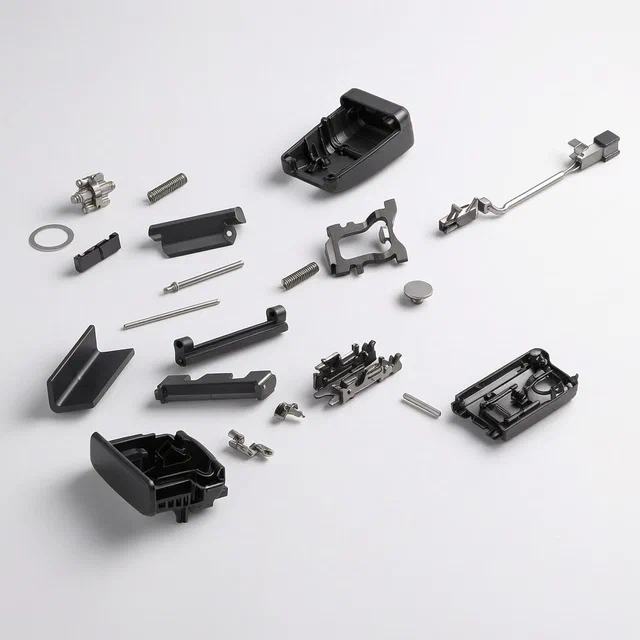
A buckle is a precision mechanical assembly. The housing is moulded engineering plastic, often glass-filled; the latch, ejector and springs are stamped and heat-treated steel; the release button is moulded and sometimes over-moulded; the tongue and webbing are separate parts of the assembly. A cover or seal adds a moulded or stamped part, a pivot and possibly a spring.
Processes. Injection moulding, stamping, heat treatment, spring winding, assembly, lubrication and end-of-line functional testing. A cover adds a mould, an assembly step and a new test check at the end of the line.
Tooling. Housing and button moulds are the significant tools, with stamping dies for the latch parts. A cover that seats in existing housing slots avoids a new housing mould, which is the difference between a change a programme can absorb mid-cycle and one that waits for the next model.
Cost drivers. Plastic grade, steel grade and heat treatment, spring quality, assembly labour, testing and traceability. The part cost is small against the validation cost, which is why the business case is a warranty case rather than a piece-price case.
Quality and testing. Buyers test insertion and release force, latch strength, cycle life, dust ingress, temperature cycling, corrosion, vibration and, for the vehicle, the crash performance of the complete assembly. A cover should be tested both on the bench and in the complete buckle, because a change that passes on the bench can still alter the certified release behaviour of the assembly.
No public source in this review breaks down component cost or lead time for buckles. The manufacturing paragraphs above are manufacturing judgment, to be replaced with supplier quotes before a commercial commitment.
6. Compliance and market entry
FMVSS 209, 49 CFR 571.209, governs seat-belt assemblies; FMVSS 208, 49 CFR 571.208, governs occupant crash protection at vehicle level; FMVSS 302, 49 CFR 571.302, governs flammability of interior materials; and California Proposition 65 may apply to coatings or plasticisers in a service part. [F4] [F5] [F6]
The practical constraint is that a buckle is a certified part. The vehicle maker certifies the assembly, so a component change is validated against the certified performance and accepted inside a running programme. That is why timing matters as much as the design: a change that arrives between programme milestones is possible, and one that arrives late waits for the next model year. [F4] [F5]
An aftermarket guard sold to consumers is a different product from the cover described here. Anything a consumer fits over a buckle can change latch release, and a belt that cannot be released quickly is a hazard, so an aftermarket route carries its own product-liability question. [F4]
The public record shows no U.S. family member for the patent linked to this report. That is an opening rather than a clearance: separate U.S. patents on buckle housings, covers and release mechanisms may still apply, and a freedom-to-operate review is required before launch.
For a U.S. launch, the practical sequence is: establish the target programme and its test plan; run insertion, release, cycle, dust, temperature and corrosion tests on the complete assembly; confirm the material selection against flammability and Proposition 65; and keep the validation records with the tier-one supplier’s file. A first-tier belt supplier already holding the nomination usually owns this process.
7. Commercial paths, risks and open questions
Path 1: bench programme with a first-tier belt supplier. The supplier holds the nomination, the validation history and the vehicle relationship; IP2M supplies the mechanism and the production package. This is the realistic route, because a vehicle maker rarely buys a buckle component directly.
Path 2: service-part supply. A cover that fits buckles already in service addresses fleets, repair chains and dusty markets, with a shorter validation path but a smaller price.
Path 3: licence to a component maker. A manufacturer that already supplies housings can add the device as a variant, which avoids a new supplier approval.
Risks. Validation cost, release-force change, cycle-life failure, dust ingress, temperature and corrosion, programme timing, and the liability of a part that affects a safety-critical release are the recurring risks. A cover that makes a belt harder to release in an emergency is not a product problem, it is a recall.
Open questions. The public record does not give buckle-level value, contamination warranty rates, validation cost or programme timing, and there is no test data for the mechanism described on the linked patent page. The grade for any single product would improve with a tier-one bench programme and passing insertion, release, dust, temperature, corrosion and cycle testing, and would fall if the cover interferes with latch release or if an FTO review finds blocking U.S. claims.
Sources
- [F1] Persistence Market Research, Automotive Seat Belt Market 2025–2032, public summary, 2025 (system value and growth).
- [F2] YH Research, Global Automotive Seat Belt Industry Research 2025–2031, public summary, 2025 (narrow scope).
- [F3] QYResearch, Automotive Seat Belt Parts 2024–2030, public summary, 2024 (component supplier landscape).
- [F4] eCFR, 49 CFR Part 571, FMVSS 208 and FMVSS 209, current.
- [F5] eCFR, 49 CFR 571.302, current.
- [F6] California Office of the Attorney General, California Proposition 65, current.
Related patent categories
Related patents
Product pages for patents that fit this market. Each page covers the mechanism, use cases, customization and patent status.