Market & Commercial Opportunity
The U.S. Solar Garden Light Market
Market size, product segments, buyer channels, competition, trends, manufacturing, compliance and the commercial opportunity in U.S. solar garden and landscape lighting.
Published November 10, 2026
Executive summary
Solar garden lights are a price-sensitive, installation-light category sold on appearance, runtime and weather resistance. Public estimates put global garden solar lights at about USD 298.81 million in 2024 with roughly 6.3% growth to 2034, and the U.S. share at about USD 71.86 million in 2024; a separate, narrower estimate puts outdoor solar landscape lighting at about USD 180 million in 2024 with 4.6% growth to 2031. The two estimates use different scopes and should not be added together. [F1] [F2]
The category sells into three different jobs: path and border lighting for appearance, security and safety lighting for a yard or driveway, and seasonal or decorative lighting for holidays and events. The buyer is usually a homeowner making a low-commitment purchase, which means the shelf, the photographs and the first-night impression decide more than the specification sheet. [F1] [F3]
Competition is broad and largely imported. Govee, Ring and Brightech are visible in the category across e-commerce, retail and direct channels, alongside a long tail of unbranded products; the sources establish presence, not market share. [F3]
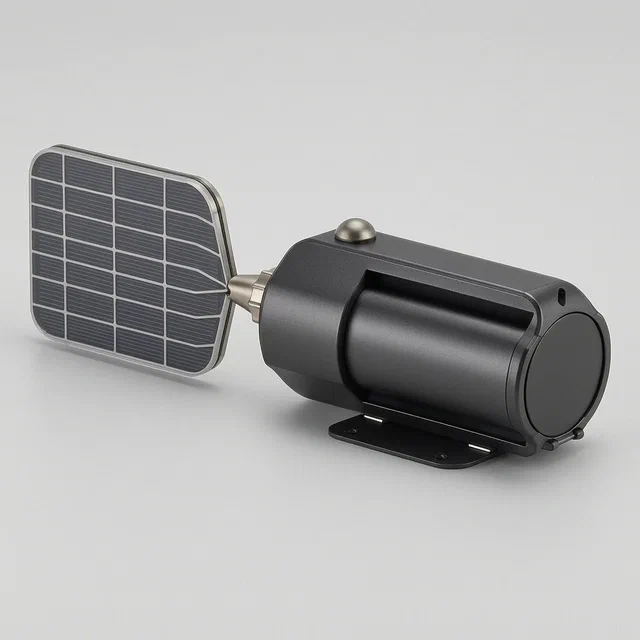
One patent on this site relates to a product sold in this market, a garden lamp whose lamp body detaches and whose solar head adjusts. It is listed at the end of this report; the market analysis below is separate from its structure.
1. Market size and growth
Global garden solar lights. Public summaries put the category at about USD 298.81 million in 2024 with reported growth near 6.3% a year to 2034, and the U.S. share at about USD 71.86 million in 2024. [F1]
Outdoor solar landscape lighting. A differently scoped estimate puts this narrower segment at about USD 180 million in 2024 with 4.6% growth to 2031. It overlaps the figure above and should be read as an alternative, not an addition. [F2]
Sub-types. No source in this review splits the category into path lights, spotlights, string lights, wall lights or decorative lamps in dollars. The segmentation below is a working one, not measured shares. [F1] [F3]
IP2M estimate. Based on the U.S. figure above, an illustrative 5% share would imply roughly USD 3.6 million at category level. That is orientation arithmetic, not a measured segment, forecast or valuation. [F1]
2. Product segments and who buys
| Segment | Typical product forms | Buyer and channel | What decides the purchase |
|---|---|---|---|
| Path and border lights | Stake-mounted path lights, bollards, border lights | Homeowners through home improvement, garden retail and e-commerce | Appearance, runtime, pack quantity, price |
| Security and safety lights | Motion-activated spotlights, wall and fence lights | Homeowners through home improvement and e-commerce | Detection range, brightness, installation effort |
| Decorative and seasonal | String lights, fairy lights, holiday and event lights | Homeowners and event buyers through mass retail and marketplaces | Look, length, colour options, price |
| Landscape and accent | Uplights, spotlights for trees and walls | Homeowners and landscapers through garden retail and distributors | Beam angle, mounting, durability |
| Smart and app-connected | Wi-Fi and app-controlled garden lights | Households through e-commerce and smart-home channels | App, ecosystem, colour control, price |
The published figures cover the category, not these rows, and the smart row is described from product types in the sources rather than from a measured volume. [F1] [F3]
Installation effort is the hidden variable. A stake light needs no wiring and sells on impulse; a wall light needs a mounting decision and sells on trust; a smart light needs an app and a network, which raises the return rate if setup fails. A mechanism that adds a step to installation has to pay for itself in the same purchase. [F1] [F3]
3. Competitive landscape
Govee, Ring and Brightech are visible in the category, sold through e-commerce, home improvement and direct channels, alongside imported products sold mainly on price. The sources establish presence and channel, not share. [F3]
The structure is layered and crowded. Ring connects garden lighting to a home-security ecosystem; Govee competes on app control, colour and price; Brightech occupies the design-led decorative shelf. Below them sits an imported long tail in which appearance and pack quantity drive the sale, and above them sits a professional landscape channel that specifies fixtures rather than retail packs. [F3]
4. Trends and innovation opportunities
Trends
Solar plus smart control. App-controlled and Wi-Fi-connected garden lights have moved from novelty to a visible segment, which raises the value of the electronics and the app rather than the fixture. [F3]
Security framing. Motion detection and camera integration let a garden light be sold as a safety product, which widens the buyer beyond decoration. [F3]
Lower installation effort. Stake and adhesive mounting keep the category impulse-driven, and products that need no wiring keep a price advantage in the retail channel. [F2] [F3]
Weather and runtime claims. Buyers read the weather rating and the first-night runtime before they compare brightness, because a failed light in the first season is the most common complaint shape in this category. This is a category reading, not a measured trend in the sources. [F3]
Innovation opportunities
The opportunities below are an analyst reading of the segment structure, not a sourced forecast.
- A body that detaches from its stake. A lamp head that lifts out of the garden fixture and works indoors or as a handheld light doubles the use case without doubling the product. What to prove: the joint seals and locks, the contact does not corrode, and the detached run time is honest.
- An adjustable solar head. A panel that can be aimed at the sun while the lamp stays aimed at the path solves a real installation problem in shaded gardens. What to prove: the hinge holds its angle through wind and seasons, the cable or contact survives rotation, and the charging gain is measured rather than claimed.
- Battery service without a new fixture. A replaceable cell turns a one-season product into a multi-season one and supports a warranty story. What to prove: the compartment seals, the cell is standard, and the cost stays inside the retail price.
- Fixtures that install without tools. Push-fit stakes and clip mounts remove the step where buyers abandon the purchase. What to prove: the mount holds in wet soil and wind, and it does not crack in frost.
5. Manufacturing and supply chain
A solar garden light is a low-cost assembly with a high sensitivity to material and sealing choices. The fixture is injection-molded plastic or die-cast aluminum; the solar panel is a small monocrystalline or polycrystalline module under glass or polycarbonate; the cell is a single lithium or NiMH battery; the light engine is an LED board with a driver; and the control electronics include a light sensor and, on smart models, a radio module.
Processes. Injection molding for housings and stakes, die casting for metal fixtures, panel lamination, board assembly, battery pack assembly, final assembly and soak testing, and packaging. Outdoor exposure adds aging and water testing to the normal electrical test.
Tooling. Housing, stake and lens molds carry most of the tooling cost. A detachable head or an articulated panel adds mold complexity and a contact assembly, and it usually changes the housing rather than adding a part, so the decision belongs before tooling.
Cost drivers. Panel wattage and efficiency, battery capacity, LED count and bin, housing material, sealing, radio module on smart models, packaging and freight. The category is heavily imported and price-led, so a mechanism has to add a visible benefit without adding a visible price.
Quality and testing. Buyers judge these products on charging in low light, runtime through the night, water ingress, frost and UV aging, and switch or sensor life. A detachable or articulated head should be tested for contact corrosion and water ingress at the joint, not only at the housing.
No public source in this review breaks down component cost or lead time for solar garden lights. The manufacturing paragraphs above are manufacturing judgment, to be replaced with supplier quotes before a commercial commitment.
6. Compliance and market entry
A detachable LED body used indoors or handheld may fall within UL 153 for portable luminaires, while a fixed outdoor fixture may be evaluated under a different listing; FCC Part 15 applies to digital or wireless electronics; a rechargeable pack may bring UL 2054; lithium cells shipped by air bring UN 38.3 rules; and California Proposition 65 warnings may apply. The applicable listing for each configuration must be confirmed with a test lab. [F4] [F5] [F6] [F7] [F8]
This review did not verify a separate mandatory federal performance standard for outdoor solar garden fixtures. That is a finding of absence in this review, not a legal conclusion that no standard exists; state rules, utility incentives, retailer requirements and voluntary standards can still add scope. [F4] [F8]
The public record shows no U.S. family member for the patent linked to this report. That is an opening rather than a clearance: separate U.S. patents on solar panel mounts, detachable lamp heads and garden fixtures may still apply, and a freedom-to-operate review is required before launch.
For a U.S. launch, the practical sequence is: fix the configuration, because a detachable head and a fixed fixture may need different listings; confirm scope with a test lab; run electrical, battery and radio tests; run water, frost and UV aging tests; review materials against Proposition 65; and keep the test records with the product file. A brand or importer already selling into the channel usually owns this process.
7. Commercial paths, risks and open questions
Path 1: OEM or private label for a garden-lighting brand or importer. The brand or importer brings the channel, warranty and compliance file; IP2M supplies the fixture mechanism and production package. This is the realistic route for a low-price category.
Path 2: component supply to a fixture maker. A detachable head or an articulated panel can be sold as a module to a maker that already has a fixture range and a retail placement.
Path 3: seasonal and promotional programmes. Decorative and gift programmes buy on unit cost and delivery date, and a visible mechanism such as a detachable light can justify a small premium in a catalogue.
Risks. Water ingress at the joint or the battery door, panel efficiency in shade, battery life across seasons, frost and UV aging, freight cost, and price competition from imported fixtures are the recurring risks. In this category the first-season failure rate matters more than the specification sheet, because the review is written after one winter.
Open questions. The public record does not provide U.S. unit volume for detachable or articulated garden lamps, willingness to pay for the extra function, or weather and cycle test data for the mechanism described on the linked patent page. The grade for any single product would improve with a committed importer pilot and passing water, frost and cycle data, and would fall if the joint cannot be sealed at the target price or if an FTO review finds blocking U.S. claims.
Sources
- [F1] Global Market Insights, Garden Solar Light Market Size & Industry Statistics 2034, public summary, 2025 (2024 data).
- [F2] Global outdoor solar landscape lighting industry research and trend analysis 2025–2031, public listing, 2025 (2024 data; narrower scope).
- [F3] Outdoor solar lighting comparison, Outdoor Solar Lights Compared: Picks That Survive a Year, brand review, 2026.
- [F4] Intertek, UL 153 standard information for portable electric luminaires, 2025.
- [F5] U.S. Federal Communications Commission, Part 15 – Radio Frequency Devices, current.
- [F6] UL Solutions, UL 2054 – Household and Commercial Batteries, current.
- [F7] International Air Transport Association, lithium-battery dangerous-goods guidance, current.
- [F8] California Office of the Attorney General, California Proposition 65, current.
Related patent categories
Related patents
Product pages for patents that fit this market. Each page covers the mechanism, use cases, customization and patent status.