Market & Commercial Opportunity
The U.S. Storage Bed Market
Market size, product segments, buyer channels, competition, trends, manufacturing, compliance and the commercial opportunity in U.S. storage and lift-up beds.
Published November 10, 2026
Executive summary
Storage beds sell space rather than style: the buyer is short of floor area and wants the bed to hold things. Public estimates put the global beds-with-storage category at about USD 2.011–2.318 billion in 2024 with reported growth of 6.6–6.8% a year, across two definitions that include wall and Murphy beds as well as lift-up and ottoman beds. [F1] [F2] No source in this review isolates lift-up beds or gives a U.S.-only figure, so the category number is an outer boundary rather than the size of this product.
Demand sits in apartments, student housing, guest rooms, small houses and hotel or contract projects, where the bed is the largest single object in the room and the only place left to store. A storage bed is therefore compared against a plain bed plus a wardrobe or under-bed boxes, not against another storage bed alone. [F1]
The competitive picture mixes furniture brands with hardware suppliers. Wall-bed and convertible specialists such as Wilding Wallbeds, SICO, Clei, More Space Place and Lagrama appear in the category, while lift mechanisms are also sold as components to furniture factories. The sources establish presence, not share. [F1]
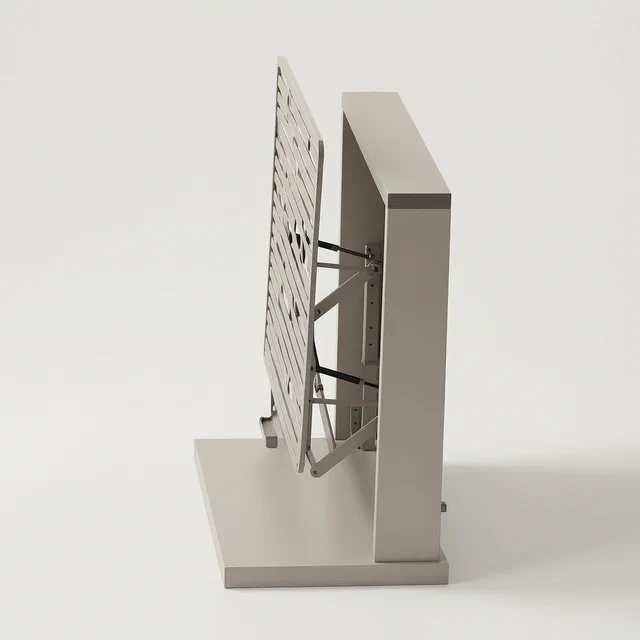
One patent on this site relates to a product sold in this market, a bed with a storage mechanism. It is listed at the end of this report; the market analysis below is separate from its structure.
1. Market size and growth
Beds with storage. Public estimates put the category at about USD 2.011–2.318 billion globally in 2024, with reported growth of 6.6–6.8% a year. The definitions include wall and Murphy beds, lift-up beds and ottoman storage beds, so the range is the outer boundary of the category rather than a lift-up segment figure. [F1] [F2]
United States. This review did not find a U.S.-only figure for the category, and none for lift-up beds alone. [F1] [F2]
Lift-up beds. No public source in this review isolates the lift-up mechanism in dollars. The segments below are a working segmentation, not measured shares. [F1]
IP2M estimate. Based on the published global range, an illustrative 5% share would imply roughly USD 100–116 million at manufacturer level. That is orientation arithmetic on an outer category boundary, not a measured segment, forecast or valuation. [F1] [F2]
2. Product segments and who buys
| Segment | Typical product forms | Buyer and channel | What decides the purchase |
|---|---|---|---|
| Lift-up storage bed | Platform beds with gas springs, full-base storage | Households through furniture retail and e-commerce | Storage volume, lift effort, safety lock, price |
| Ottoman and drawer bed | Drawer bases, foot-end storage, upholstered ottoman beds | Households through furniture retail and e-commerce | Access, finish, mattress fit |
| Wall and Murphy bed | Folding beds that store vertically | Households and contract buyers through specialists | Installed footprint, mechanism safety, installation |
| Storage headboard | Beds with shelving or cupboards in the headboard | Households through furniture retail | Storage type, headboard depth, look |
| Contract and student beds | Durable storage beds for apartments, dorms and hotels | Property operators and contract buyers through distributors | Durability, assembly, replacement parts, safety |
The published figures cover the whole category, not these rows. The wall-bed and contract rows are described from product types and channels in the sources, not from measured volumes. [F1]
The buyer’s trade-off is explicit. A lift-up bed gives a large single storage volume but requires a clear space beside the bed to raise the platform and enough strength to lift it. A drawer bed gives easier access but less volume and needs clearance at the foot or side. A wall bed stores the whole footprint but needs an installed mechanism the household cannot easily move. [F1]
3. Competitive landscape
The category includes wall-bed and convertible specialists such as Wilding Wallbeds, SICO, Clei, More Space Place and Lagrama, and lift hardware is also sold by component suppliers to furniture factories. The sources establish presence and channel, not share or direct substitutability. [F1]
The structure is split between specialists and component supply. A specialist sells an installed system with a mechanism, a warranty and, often, installation; a furniture factory buys a lift mechanism and builds a platform bed around it. A new mechanism can enter through either route, but the buyer and the proof requirement differ: the specialist wants a tested system, the factory wants a part that fits its existing carcass. [F1] [F3]
4. Trends and innovation opportunities
Trends
Small-space living. Storage furniture is tracked inside the beds-with-storage category, and the growth reported for that category is consistent with apartments, student housing and smaller homes absorbing the demand. [F1] [F2]
Contract and hospitality. Hotels, serviced apartments and student housing buy storage beds in volume and judge them on durability, replacement parts and assembly time rather than on appearance alone. [F1]
Upholstered storage beds. Ottoman-style beds with a fabric finish have moved storage from a utility feature into the design shelf, which raises the importance of the lift mechanism being easy and quiet. This is a product-form observation from the channel, not a measured trend in the sources. [F1]
Safety claims. A heavy platform that lifts on gas springs is a hazard if it closes under its own weight, and buyers and retailers increasingly ask for a locking or damping story. This is a product-safety reading, not a measured trend.
Innovation opportunities
The opportunities below are an analyst reading of the segment structure, not a sourced forecast.
- A lift that cannot fall. A mechanism that locks in the raised position and releases only on a deliberate action protects hands and removes a liability from the retailer. What to prove: the lock engages every cycle, it holds a loaded platform, and it can be released by one adult but not by a child playing underneath.
- One-handed lift for a heavy mattress. Assist that lets one person raise a loaded platform suits renters and small households. What to prove: the lift force stays within an agreed limit across the stroke, the springs do not surge, and the closed platform seats without a gap.
- Storage that stays clean. A sealed or lipped storage base keeps dust and pests out of bedding stored for months. What to prove: the joint closes against the frame, the seal survives repeated opening, and the added parts do not raise the closed height beyond the mattress standard.
- Serviceable springs and hinges. A mechanism whose gas springs and hinges can be replaced without dismantling the bed suits the contract and hospitality channel. What to prove: the part is reachable, the mounting is standard, and the replacement does not require two people.
5. Manufacturing and supply chain
A storage bed is a board-and-metal assembly. The platform and frame are particle board, MDF or plywood, finished with laminate, veneer or fabric; the lift mechanism is a pair of gas springs or a linkage with mounting brackets; the base is a fabric-lined box or a board carcass; slats are beech, birch or laminated veneer.
Processes. Board cutting, edge banding, drilling, lamination or upholstery, metal bracket stamping and welding, gas-spring assembly, and final assembly or flat-pack. Upholstered versions add foam cutting, sewing and stapling, which puts them in a different factory from plain board beds.
Tooling. Board beds need CNC programs and drill patterns rather than molds. The mechanism brings stamping dies, weld fixtures and assembly jigs, and a change in the lift geometry usually means new brackets rather than a new bed.
Cost drivers. Board grade, gas-spring quality and force rating, bracket steel, upholstery, slat material, packaging and freight. A safety lock or damper adds parts and assembly time, so it has to be sold as a safety or ease-of-use feature rather than absorbed silently in the price.
Quality and testing. The tests that decide a contract sale are lift cycle life, lock engagement, static load on the platform, stability with the platform raised and, for upholstered beds, seam strength and fabric wear. A lift mechanism should be cycle-tested with a mattress on the platform, not empty.
No public source in this review breaks down component cost or lead time for storage beds. The manufacturing paragraphs above are manufacturing judgment, to be replaced with supplier quotes before a commercial commitment.
6. Compliance and market entry
Furniture sold in the United States faces general product-safety rules. CPSIA lead limits, testing, certification and tracking labels apply where a children’s product is covered; the 16 CFR 1500.48 and 1500.49 sharp-point and sharp-edge tests apply to articles intended for children under eight; 16 CFR 1303 limits lead in paint and coatings; and California Proposition 65 warnings may apply. ASTM F1487 covers public playground equipment and does not apply to this bed. [F3] [F4] [F5] [F6] [F7]
This review did not identify a product-specific mandatory federal performance standard for adult storage beds. That is a finding of absence in this review, not a legal conclusion that no standard exists; state rules, contract specifications and voluntary standards can still add scope. [F3] [F7]
The public record shows no U.S. family member for the patent linked to this report. That is an opening rather than a clearance: separate U.S. patents on bed-lift mechanisms, gas-spring mounts and storage bases may still apply, and a freedom-to-operate review is required before launch.
For a U.S. launch, the practical sequence is: confirm whether the product is a children’s product; run lead, sharp-point and sharp-edge tests where they apply; run lift and lock cycle tests with a loaded platform; review finishes against Proposition 65; and keep the test file with the product. A contract furniture supplier or brand already selling into the channel usually owns this process.
7. Commercial paths, risks and open questions
Path 1: component supply to a bed maker. The lift mechanism, lock or storage base is sold to a factory that already builds platform beds. This is the lowest-volume, highest-margin route and the fastest to test with one partner.
Path 2: OEM or private label for a furniture brand. The brand brings the retail or contract channel and the warranty process; IP2M supplies the mechanism and production package. This suits a mechanism that needs to be shown and tried.
Path 3: contract supply for apartments, student housing and hospitality. Volume orders with durability and parts-availability requirements, usually through a distributor or a fit-out contractor.
Risks. Gas-spring failure or force drift, a lock that does not engage, platform instability when raised, mattress weight assumptions that differ from the test, upholstery damage in transit, and price competition from imported beds are the recurring risks. A platform that falls once ends the account and invites a safety claim.
Open questions. The public record does not provide U.S. volume for lift-up beds, willingness to pay for a safety lock or assisted lift, or cycle data for the mechanism described on the linked patent page. The grade for any single product would improve with a committed factory pilot and passing lift, lock and load data, and would fall if the mechanism cannot fit an existing carcass or if an FTO review finds blocking U.S. claims.
Sources
- [F1] Global Info Research, global beds-with-storage report, public summary, 2025 (2024 data; includes wall beds).
- [F2] QYResearch Japan, beds-with-storage report, public summary, 2024 (2023 data; definition differs).
- [F3] U.S. Consumer Product Safety Commission, Highlights of Requirements for Furniture Sold in the United States, guidance, current.
- [F4] eCFR, 16 CFR Part 1500, current.
- [F5] eCFR, 16 CFR Part 1303, current.
- [F6] California Office of the Attorney General, California Proposition 65, current.
- [F7] ASTM International, ASTM F1487-25, Standard Consumer Safety Performance Specification for Playground Equipment for Public Use, 2025 (not applicable to this bed).
Related patent categories
Related patents
Product pages for patents that fit this market. Each page covers the mechanism, use cases, customization and patent status.