Market & Commercial Opportunity
The U.S. Vanity Dresser Market
What the public record shows about the U.S. vanity dresser market: adjacent size data, product segments, buyers, competition, trends, manufacturing and compliance.
Published November 10, 2026
Executive summary
Vanity dressers are sold inside the much larger home-furniture category, and this review did not find a public source that isolates them. The honest starting point is therefore an absence: there is no published dollar figure for vanity dressers, no U.S.-only number, and no named specialist brand list in the sources reviewed. [F1] [F2] [F3]
What the public record does support is the shape of the adjacent market. Folding and multi-use furniture is estimated at about USD 10.0 billion globally in 2024 with 5.9% growth to 2030, and beds with storage at about USD 2.011–2.318 billion in 2024 with 6.6–6.8% growth; both include residential, contract and small-space products well beyond a dressing table. [F1] [F2] Those figures mark the boundary of the furniture market around a vanity, not its size.
The buyer is a household making a room-level decision: a bedroom, a dressing area or a small apartment where the vanity also has to store. Purchase is driven by appearance, delivered size, assembly time and price, which is why the retail and e-commerce channel matters more here than in contract furniture. [F3]
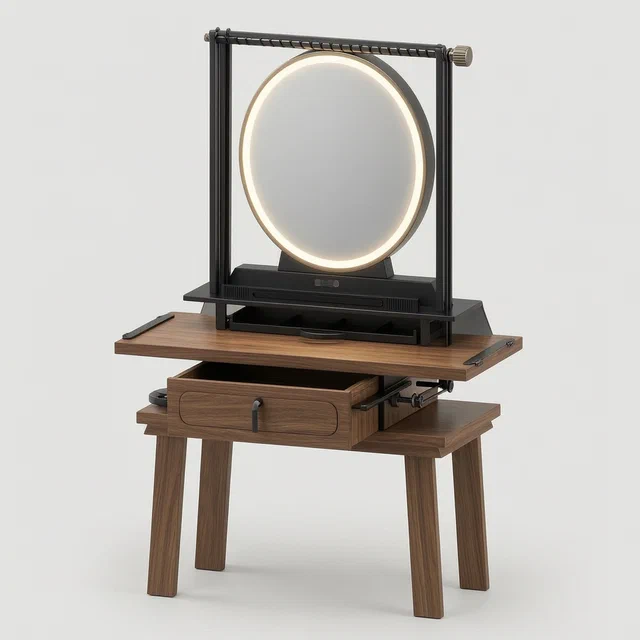
One patent on this site relates to a product sold in this market, a vanity dresser whose mirror and storage adjust. It is listed at the end of this report; the market analysis below is separate from its structure.
1. Market size and growth
Vanity dressers. No public source in this review isolates the segment in dollars, and none gives a U.S.-only figure. Any number quoted for this product would be a guess dressed as data, so this report does not quote one. [F1] [F2] [F3]
Adjacent categories. Folding and multi-use furniture is estimated at about USD 10.0 billion globally in 2024 with 5.9% growth to 2030. Beds with storage are estimated at about USD 2.011–2.318 billion in 2024 with 6.6–6.8% growth under two definitions. Both are outer boundaries for home and small-space furniture, not vanity figures. [F1] [F2]
IP2M estimate. With no segment base, a share-of-category calculation would be arithmetic on an unknown. This report therefore gives no dollar estimate for the vanity niche and treats the adjacent figures as context only. [F1] [F2]
2. Product segments and who buys
| Segment | Typical product forms | Buyer and channel | What decides the purchase |
|---|---|---|---|
| Dressing table with mirror | Table, fixed or tilting mirror, stool | Households through furniture retail and e-commerce | Appearance, mirror size, delivered price |
| Compact and small-space vanity | Wall-leaning, corner and narrow-depth units | Renters and apartment households through e-commerce | Footprint, assembly time, delivery |
| Storage vanity | Drawers, compartments, jewellery or cosmetic storage | Households through furniture retail and e-commerce | Storage volume, drawer feel, finish |
| Adjustable vanity | Tilting or height-adjustable mirror, adjustable shelf | Households and contract buyers through furniture retail | Adjustment range, stability, mechanism feel |
| Children’s vanity | Low-height sets, play furniture | Families through mass retail and e-commerce | Safety, size, price, colour |
The segment rows are built from product types rather than measured volumes, because the sources do not break the category down. [F1] [F3]
The channel shapes the product more than the category does. An e-commerce vanity is bought from photographs against a delivery date and an assembly estimate; a furniture-retail vanity is bought in a showroom where the drawer action and the mirror tilt can be tried. The same unit rarely suits both without a change to packaging, assembly and cost. [F3]
3. Competitive landscape
This review did not find a public source that names vanity-dresser specialists or reports their share. The adjacent retail furniture channel is served by folding-furniture sellers such as Lifetime Products, Cosco, Meco and National Public Seating, but those products are not substitutes for a vanity and the source only establishes channel presence. [F3]
What can be said from the channel structure is that the category is split between branded furniture ranges sold through retail and a long tail of imported or private-label units sold online. Brand matters less than the photograph, the delivery promise and the reviews, and a new mechanism competes for attention against a large set of visually similar products. [F3]
4. Trends and innovation opportunities
Trends
Small-space furniture. Compact and wall-leaning formats are part of the broader multi-use furniture demand the adjacent categories track, and they suit renters and apartments where floor area is fixed. [F1] [F2]
E-commerce and flat-pack. The retail channel’s shift toward online purchase rewards products that pack flat, assemble with simple tools and survive parcel delivery. [F3]
Integrated mirror lighting. Vanities increasingly carry built-in LED lighting around the mirror, which moves the product closer to lighting compliance and adds an electrical component to a furniture item. This is a product-form observation from the channel, not a measured trend in the sources. [F3]
Storage as the differentiator. Drawer count, internal dividers and jewellery or cosmetic compartments are visible in listing photographs and are used to justify a price step within the category. [F3]
Innovation opportunities
The opportunities below are an analyst reading of the segment structure, not a sourced forecast.
- Mirror and shelf that adjust together. A vanity whose mirror tilts and whose shelf follows the tilt keeps cosmetics within reach at any angle, which is easy to show in a short video. What to prove: the joint holds its angle without drifting, the shelf does not spill when tilted, and the mechanism survives a loaded drawer being slammed.
- Storage that uses the depth. A unit that uses the full depth behind the mirror for shallow drawers adds capacity without adding footprint. What to prove: the drawers run true after flat-pack assembly, and the added depth does not push the unit away from the wall.
- Flat-pack with one tool. A vanity that assembles with a single tool and a short instruction sheet fits the e-commerce return model. What to prove: the cam and bolt joints hold after repeated moves, and the packed carton survives parcel handling.
- Lighting and power at the vanity. A mirror light with a shaver socket or USB port matches how the product is used, but it adds electrical certification to a furniture item. What to prove: the wiring passes listing and the light does not compromise the mirror mounting.
5. Manufacturing and supply chain
A vanity dresser is a board-and-hardware product with an optical component. The carcass and top are particle board or MDF, finished with laminate, veneer, paint or foil; drawers run on metal or plastic runners; the mirror is a bought-in glass part with a safety backing where required; hinges and adjustable feet are standard hardware. Lighting, where present, adds an LED strip, a driver and a switch.
Processes. Board cutting, edge banding, drilling, foil or paint finishing, mirror cutting and edging, hardware installation and flat-pack assembly. Glass handling adds a breakage step that board furniture does not have.
Tooling. There is little hard tooling compared with injection-molded products: the cost sits in CNC programs, drill patterns, edge-banding setups and packing design. A mechanism that changes the mirror mount or the drawer layout changes the drilling pattern rather than a mold, which makes variants cheaper than in plastics.
Cost drivers. Board grade and thickness, finish, mirror size and thickness, runner quality, hardware count, carton design and freight. A tilting or adjusting mechanism adds hardware and assembly time, so it has to be visible in the photograph and priced inside the retail band.
Quality and testing. Buyers judge a vanity on finish, drawer action, mirror flatness, stability when a drawer is open and, for flat-pack, whether the joints stay tight after a move. A moving mirror mount should be cycle-tested with the unit loaded, and the glass should be packed to survive the parcel network.
No public source in this review breaks down component cost or lead time for vanity dressers. The manufacturing paragraphs above are manufacturing judgment, to be replaced with supplier quotes before a commercial commitment.
6. Compliance and market entry
Furniture sold in the United States faces general product-safety rules. The 16 CFR 1303 lead-paint limit applies where coatings are present, California Proposition 65 warnings may be required, and a product marketed for children brings CPSIA lead limits, testing, certification and tracking labels, plus the 16 CFR 1500.48 and 1500.49 sharp-point and sharp-edge tests for articles intended for children under eight. Mirror glass and electrical components can add further requirements. [F4] [F5] [F6] [F7]
This review did not identify a product-specific mandatory federal performance standard for adult vanity dressers. That is a finding of absence in this review, not a legal conclusion that no standard exists; state rules, retailer requirements and voluntary standards can still add scope. [F4] [F6]
The public record shows no U.S. family member for the patent linked to this report. That is an opening rather than a clearance: separate U.S. patents on adjustable mirrors, vanity storage and furniture fittings may still apply, and a freedom-to-operate review is required before launch.
For a U.S. launch, the practical sequence is: confirm whether the product is a children’s product; run lead, sharp-point and sharp-edge tests where they apply; review coatings and materials against Proposition 65; if lighting is included, add the electrical listing for that component; and keep the test file with the product. A retailer or furniture brand already selling into the channel usually owns this process.
7. Commercial paths, risks and open questions
Path 1: private label for an e-commerce furniture seller. The seller brings the listing, reviews and delivery network; IP2M supplies the mechanism, packing design and production package. The price band is tight and the return rate is the measure of success.
Path 2: OEM for a furniture brand or retail chain. A branded range adds showroom placement and a warranty process, which suits a mechanism that needs to be tried before it is bought.
Path 3: component supply. A drawer, mirror mount or adjusting mechanism can be sold to a vanity maker as a module, which is the lowest-volume and easiest-to-test route.
Risks. Glass breakage in transit, flat-pack assembly failure, drawer misalignment, finish damage at edges, and price competition from visually similar imports are the recurring risks. In this category a broken mirror on delivery costs more than the margin on several units.
Open questions. The public record provides no U.S. volume, price band or brand share for vanity dressers, and no test data for the mechanism described on the linked patent page. The grade for any single product would improve with a committed seller pilot and passing transit and cycle tests, and would fall if the mechanism cannot survive parcel handling at the target price.
Sources
- [F1] Global Industry Analysts, Folding Tables – Global Market Trajectory & Analytics, public summary, 2024 (adjacent category only).
- [F2] Global Info Research, storage beds market report, public listing, 2025 (adjacent category only).
- [F3] Maia Research, Global Folding Tables & Chairs Industry Trends Analysis Report 2025, public listing, 2025 (retail channel only).
- [F4] U.S. Consumer Product Safety Commission, Highlights of Requirements for Furniture Sold in the United States, guidance, current.
- [F5] eCFR, 16 CFR Part 1303, current.
- [F6] California Office of the Attorney General, California Proposition 65, current.
- [F7] eCFR, 16 CFR Part 1500, current.
Related patent categories
Related patents
Product pages for patents that fit this market. Each page covers the mechanism, use cases, customization and patent status.