
Patent CN215456818U
Updated November 8, 2026Clamp-On Portable High Chair with Adjustable Legs and Fabric Seat
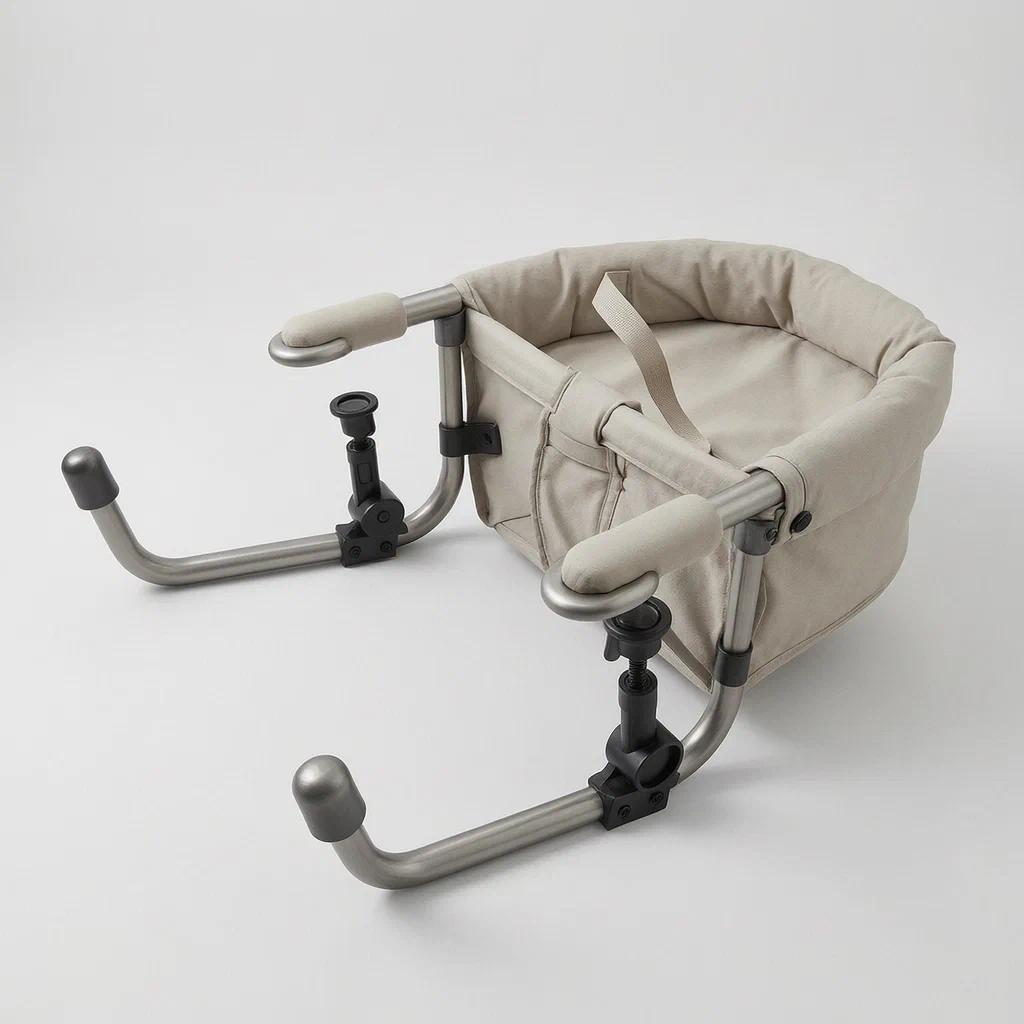
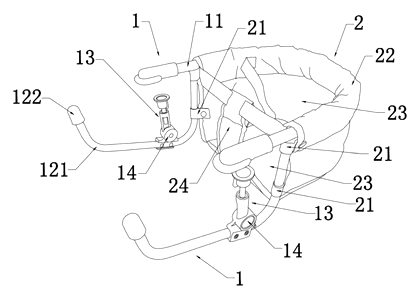
Traditional high chairs take up floor space and are difficult to store when not in use. This design solves the problem by converting any standard dining table into a safe seating area for young children. It uses a pair of clamp-on feet that grip the table edge from above and below. An internal telescopic screw adjusts the grip strength and height to accommodate tables of varying thicknesses. The feet are joined by a rigid U-frame, over which a durable fabric seat is stretched, complete with a T-shaped restraint belt to keep the child securely seated while eating.
- China utility model - In force
- No filings outside China
- Baby & Kids / Feeding
- Steel tube forming, PP/ABS molding, Fabric sewing
Splat! What let you down?
🔒
Secure Clamp Grip
Upper and lower arms sandwich the table edge, adjusted by a telescopic screw for tight fit.
📏
Adjustable Fit
Telescopic legs allow the chair to mount on tables of various thicknesses.
🧵
Fabric Safety Seat
Durable fabric cover with T-shaped belt provides restraint and comfort on the U-frame.
📦
Space Saving
Compact design attaches directly to existing furniture, eliminating the need for bulky storage.
Bring this product to market
- ✓ Patent review Patent family and legal status reviewed in the relevant jurisdictions.
- 2 Product brief · now How it works, uses and options written up
- 3 Prototype First samples for buyers to review
- 4 Pilot run Small first batch for launch customers
- 5 Volume production Repeat orders at scale
Buyer interest
– of 100 buyers needed to start prototyping
One click, no sign-up. Each vote is one real visitor, and products with the most interest go to prototyping first.
Build team: no members yet. Need a partner, co-funding or skills to build this? Join and we introduce the team once it forms.
Patent Rights & Team Participation
Before joining a development team, participants should ensure they have the necessary rights or authorization to participate in the project.
Participation is generally appropriate where:
- You own the relevant patent rights or have obtained permission or a license from the rights holder.
- The relevant patent rights have expired or have been legally invalidated in the jurisdictions where the planned activities will take place.
- The planned development, manufacturing, and commercialization activities have been independently assessed and do not infringe applicable patent rights in the relevant jurisdictions.
Important: Being located outside a country where a patent is protected does not automatically exempt you from patent infringement risks. Patent rights may apply based on where development, manufacturing, use, sale, or import activities take place.
IP2M does not grant any patent license or authorization through team participation. Joining a project does not provide permission to use, manufacture, or commercialize patented technology.
The problem
Standard high chairs occupy significant floor space and are often cumbersome to move between rooms. Parents frequently struggle to find a stable seating solution for toddlers during meals when traveling or visiting homes with limited space. Existing clamp-on seats may lack sufficient adjustment mechanisms to fit diverse table thicknesses, leading to instability or damage to the furniture surface. There is a need for a portable, secure, and adaptable seating device that can be quickly installed on most dining tables without complex assembly.
The solution
The patented design introduces a dual-clamp system that attaches directly to the edge of a dining table. Two symmetrical chair feet are used, each comprising an upper arm that rests horizontally on the tabletop and a lower arm that abuts the table’s underside. These arms are connected by a flexible telescopic arm featuring an adjusting screw rod, allowing the user to tighten the grip against the table based on its specific thickness.
The two chair feet are linked together by a U-shaped connecting frame, which serves as the structural backbone for the seat. A fabric chair cover is sleeved over this frame, incorporating a T-shaped belt to restrain the child. Anti-slip sleeve heads made of rubber are placed on the contact points to prevent slipping and protect the table surface. The entire assembly rotates slightly via elastic telescopic rods within strip-shaped openings, facilitating easy folding and storage when not in use.
Who it is for
- Traveling Families: Parents who need a reliable feeding solution for toddlers in hotels, relatives’ houses, or restaurants where dedicated high chairs are unavailable or unsanitary.
- Small Apartment Dwellers: Urban families with limited floor space who cannot accommodate bulky traditional high chairs but still require a safe seating option for meal times.
- E-commerce Brands: Sellers looking for lightweight, compact products that reduce shipping costs and appeal to modern parents seeking minimalist nursery gear.
- Wholesalers & Distributors: B2B buyers targeting the baby accessories market with a product that offers universal compatibility through its adjustable clamping mechanism.
How it works
The main parts
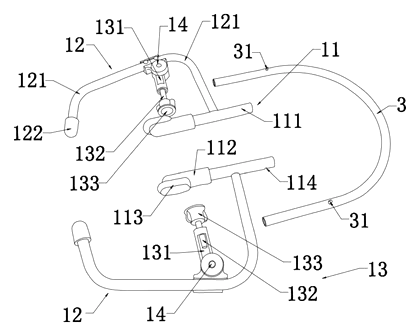
| No. | Part | What it does |
|---|---|---|
| 1 | Chair Feet | Symmetrical clamps that grip the table edge. |
| 11 | Upper Arm | Rests on the tabletop; contains pipe structure for rotation. |
| 112 | Anti-slip Sleeve Head | Rubber cap on upper arm to prevent slipping and protect surface. |
| 12 | Lower Arm | U-shaped steel tube abutting the table underside. |
| 13 | Telescopic Arm | Adjustable screw mechanism to tighten the clamp. |
| 3 | U-Shaped Connecting Frame | Links the two feet and supports the seat. |
| 2 | Chair Cover | Fabric seat with integrated safety belts. |
| 21 | Fastening Belts | Side straps to secure the cover to the feet. |
| 24 | T-Shaped Belt | Central restraint belt for the child. |
Operating Steps
- Positioning: Place the two chair feet on opposite sides of the dining table edge. The upper arms rest on top, and the lower arms hang beneath.
- Adjustment: Turn the adjusting screw rods on the telescopic arms to bring the butt joint heads into contact with the table underside. Tighten until the anti-slip sleeves grip the tabletop firmly.
- Assembly: Connect the two feet using the U-shaped frame. Slide the frame into the rotating openings on the upper arms.
- Seat Installation: Stretch the fabric chair cover over the U-shaped frame. Secure the side fastening belts to the chair feet.
- Usage: Place the child in the seat and buckle the T-shaped belt across their body for safety.
Applications
Home Dining Rooms
Ideal for families with limited kitchen space who want to keep the floor clear. The chair attaches directly to the existing dining table, removing the need for a separate piece of furniture that blocks walkways.
Travel and Hotels
Perfect for parents staying in Airbnbs or hotels. The compact size allows it to be packed easily in luggage, providing a familiar and safe eating environment for toddlers away from home without relying on potentially dirty public high chairs.
Restaurants and Cafes
Useful for establishments that do not have enough space for multiple standalone high chairs. Staff can quickly install the unit on a standard table upon request, enhancing customer service for dining families.
Visiting Relatives
Allows grandparents or friends to host young grandchildren or nieces/nephews comfortably. Since many older homes lack modern high chairs, this portable solution ensures the child has a proper seat during visits.
Where it is less suitable
- Tables with Overhangs: Not suitable for tables where the apron or leg structure prevents the lower arm from reaching the underside.
- Glass or Fragile Tops: The clamping pressure might risk damaging delicate surfaces unless protective pads are extensively tested and approved for such materials.
- Very Thick Tables: If the table thickness exceeds the maximum extension of the telescopic screws, the chair will not fit securely.
Patent & Production
At a glance
| Patent number | CN215456818U (application CN202122110698) |
| Type | China utility model (实用新型) - protects product shape and structure |
| Original title | Novel Dining Table Chair for Children (一种儿童用的新型餐桌椅) |
| Patent owner | Fujian Oubeibi Children’s Products Co ltd |
| Inventors | Hu Junjian |
| Filing date | 2021-09-02 |
| Grant date | 2022-01-11 |
| Status (China) | In force - valid until at most 2031-09-02, provided annual fees are paid |
| Patent family | Public record shows Chinese filings only - no US, European, Japanese, PCT or other filings listed |
| Cited by | 0 later documents |
| Source | Google Patents (search for CN215456818U) |
What the claims cover, in plain language
Claim 1 defines a novel dining table chair for children comprising two symmetrical chair feet and a chair cover. Each chair foot includes an upper arm, a lower arm, and a flexible (telescopic) arm. The upper arm is set horizontally on the tabletop, cooperating with the lower arm and flexible arm. The lower arm is rigidly coupled to the upper arm and abuts the table bottom. The flexible arm is rotatably installed on the lower arm via a rotating seat and abuts the table bottom. The two chair feet are connected by a U-shaped link. The chair cover is sleeved over the U-shaped link, equipped with two fastening belts on its sides, and installs mutually with the chair feet.
Claim 2 specifies that the upper arm has a pipe arm with an anti-slip sleeve head sleeved on its end to prevent slipping on the tabletop. The sleeve head has a bottom pad with anti-slip lines.
Claim 3 states the anti-skid sleeve head, bottom pad, and anti-skid grains are integrally manufactured.
Claim 4 describes the lower arm as having two bending parts and a U-shaped structure, with one end fixed to the upper arm and the other sleeved with a rubber head to abut the table bottom.
Claim 5 details the telescopic arm arranged between the bending parts, comprising a sleeve, an adjusting screw rod, and a butt joint head. The screw rod threads into the sleeve to adjust the distance between the butt joint head and the upper arm’s anti-slip sleeve head.
Claim 6 mentions a strip-shaped rotating opening on the upper arm’s sidewall, where the U-shaped connecting frame is movably arranged via an elastic telescopic rod.
Claim 7 defines the chair cover as consisting of an upper cover, a seat cover, and a T-shaped belt, connected to form the seating area on the U-shaped frame.
This is a simplified reading for orientation only. The legal scope is defined by the exact claim wording in the official Chinese document.
What this means for US production
This patent was filed in China and is currently in force. The public record shows no US or other foreign counterpart. Making or selling this specific design in China would require the owner’s permission. However, because there is no US patent, the design itself is not restricted in the United States.
Two points to settle early:
- Other patents may exist. The baby gear sector is heavily patented, particularly regarding clamp mechanisms and safety standards. While this specific utility model has no foreign citations, independent US patents may cover similar clamp-on high chair structures or safety features. A freedom-to-operate (FTO) review is recommended before launching in the US market.
- Safety Standards Compliance. Regardless of patent status, US sales must comply with strict consumer product safety regulations (e.g., ASTM F1235). Design modifications may be necessary to meet these standards, which could alter the product structure.
Customization and manufacturing
What can be customized
| Area | Options |
|---|---|
| Table Compatibility | Adjust screw length and range to fit thicker or thinner table edges. |
| Materials | Steel tube thickness for load capacity; fabric types (polyester, cotton blends) for durability and aesthetics. |
| Colors & Patterns | Custom dyeing for fabric covers; powder coating colors for metal frames. |
| Safety Features | Enhanced belt buckles, additional padding, or wider base stabilizers if needed for local codes. |
| Packaging | Compact retail boxes vs. bulk wholesale packaging. |
Things to plan for (US market)
- ASTM F1235 - Standard Consumer Safety Specification for Booster Seats. Although this is a clamp-on high chair, elements of booster seat standards regarding restraint systems and stability apply.
- CPSC Guidelines - General requirements for children’s products, including lead content in paint/coatings and phthalates in plastics.
- 16 CFR 1501 - Small Parts Regulation: Ensure no detachable small parts pose choking hazards.
- Flammability - Fabrics must meet specific flammability standards for children’s sleepwear and accessories (though high chairs are distinct, general textile safety applies).
How a project runs
- Inquiry - Define target table thickness range, load capacity, and aesthetic preferences.
- Design Refinement - CAD modeling of the telescopic mechanism and seat geometry to ensure ergonomic fit and safety compliance.
- Prototyping - Create functional samples using 3D printing for fit checks and CNC machining for critical load-bearing components.
- Testing - Conduct static load tests, tip-over tests, and small-parts/bite-force tests per ASTM/CPSC guidelines.
- Production - Finalize tooling for injection molded parts and fabric cutting/sewing patterns. Begin mass production after passing pre-production inspection.
Quantities & timeline
Tooling for plastic components (sleeves, knobs) typically takes 4-6 weeks. Metal tube forming dies require 3-5 weeks. Fabric sourcing and sewing line setup adds another 2-3 weeks. Initial prototypes are available within 2 weeks of design freeze. Full production lead time depends on order volume but generally starts 8-10 weeks after tooling approval. Send us your specifications, estimated quantity, and target launch date and we will reply with options.
Patent drawings
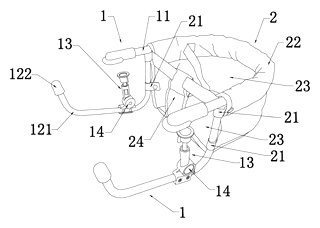
Drawings reproduced from the public patent document for reference.
Production notes
Tooling and process
Manufacturing likely involves steel tube forming for the upper and lower arms, followed by press-fit assembly. Plastic components like the adjusting screw handles and anti-slip caps typically use PP or ABS injection molding. The fabric seat requires precision cutting and sewing. Assembly relies on snap-fits for plastic covers and screws with thread lock for mechanical joints.
Cost drivers
Key cost factors likely include material certification for safety-compliant plastics and fabrics, part count complexity, and rounded edges/tooling for metal tubes to prevent injury. Packaging design also impacts logistics costs due to the product’s shape.
Prototyping path
We would typically start with a 3D-printed fit sample to verify the telescopic mechanism’s range. Proceed to material certificates for fabric and plastic. Build a load sample using actual steel tubes to test weight capacity. Perform small-parts and pinch tests before finalizing tooling.
What we would change before tooling
We would likely refine the thread engagement of the adjusting screw to ensure consistent torque resistance. Wall thickness of the steel tubes should be optimized to balance weight and rigidity. Joint designs for the U-frame connection need reinforcement to avoid stress fractures.
Common failure points
Issues typically include spring fatigue in the elastic telescopic rods, tipping if the center of gravity shifts excessively, and flammability risks if fabric treatments degrade. Pinch points at the clamp interface and small parts detaching from the belt buckles are critical safety concerns to address.
Frequently asked questions
Does this chair fit all dining tables?
The patent describes an adjustable telescopic mechanism that allows the clamp to accommodate tables of different thicknesses. However, it requires a table with a straight edge and accessible underside. Tables with thick aprons or unusual shapes may not fit. Specific thickness ranges should be confirmed in design.
Is the fabric seat washable?
The patent mentions a fabric chair cover with fastening belts. While it doesn’t specify washing instructions, removable covers are typically designed for easy cleaning. Material selection (e.g., polyester vs. cotton) affects washability and durability, which is determined during the prototyping phase.
How secure is the clamp mechanism?
The design uses an adjusting screw rod to tighten the clamp against the table. The patent includes anti-slip rubber sleeves on both the top and bottom contact points to enhance grip and protect the table surface. Stability is verified through load testing during development.
Can the chair be folded for storage?
Yes, the patent describes a U-shaped connecting frame with elastic telescopic rods that allow the chair feet to rotate in opposite directions. This feature facilitates compact folding and easier storage when the chair is not in use.
What safety standards does it meet?
The patent itself does not list certifications. For US sales, the product must comply with ASTM F1235 and CPSC regulations. We recommend conducting third-party testing on prototypes to ensure adherence to current safety standards before mass production.
Is there a weight limit for the child?
The patent does not specify a weight limit. Load capacity depends on the steel tube thickness, plastic component strength, and fabric durability. These parameters are set in design and confirmed on prototypes through rigorous static and dynamic load tests.
Can this design be made and sold in the US?
The patent is in force in China, but the public record shows no US counterpart. Therefore, making or selling this specific design in the US is not restricted by this patent. However, other US patents may exist in the baby gear field, so a freedom-to-operate review is advised.
Are you affiliated with the patent owner?
No. IP2M is an independent design and manufacturing service working from the public patent document.
Request a quote
Click Request a Quote below to see our email address - copy it, or open your email app with a ready-made message. Please mention patent CN215456818U in the subject.
Helpful details to include:
- Your company and channel (baby brand, retailer, wholesaler)
- Target table thickness range and load capacity requirements
- Material preferences for fabric and plastics
- Estimated quantity and target price
- Timeline - when you would like samples and the first shipment
You can also reach us at (332) 203-9997.
Page editor: Daniel Chen, Product Research Editor · IP2M
Last updated November 8, 2026. If something on this page looks wrong, email [email protected] and we will check it against the patent.
Interested in building this?
Tell us your target market, quantity and timeline. We reply with options for prototyping, small-batch runs or volume production.
Send your inquiry to
Please put CN215456818U in the subject line and tell us your company, country, estimated quantity and timeline.
Prefer to talk? Call (332) 203-9997.
More product-ready patents
All Baby & Kids patents →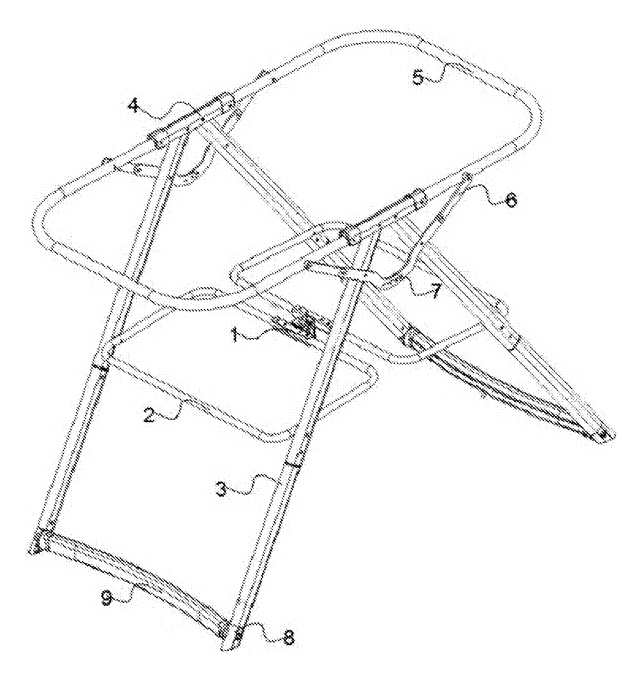
Baby & Kids
Portable Folding Rocking Bassinet Frame
Rocking bassinet frame that folds flat: telescopic hub, folding rails, two-part legs, curved rockers.
Patent CN206910143U
Baby & Kids
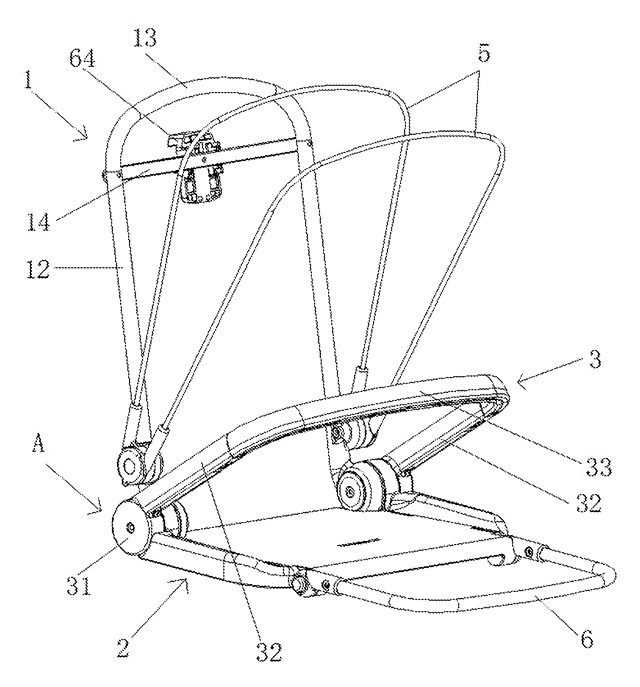
Stroller Seat with Linked Fold-Away Armrest
Stroller seat whose armrest unlocks and folds automatically when the backrest is folded forward.
Patent CN206856772U
Baby & Kids
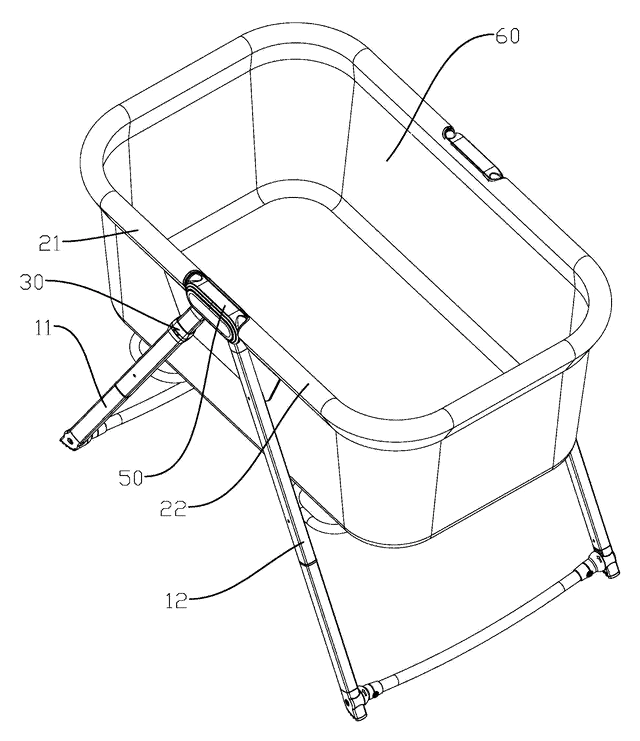
One-Motion Folding Baby Crib with Linked Frame
Portable baby crib whose top rails fold down automatically as the A-frame legs are closed.
Patent CN207202585U
Baby & Kids
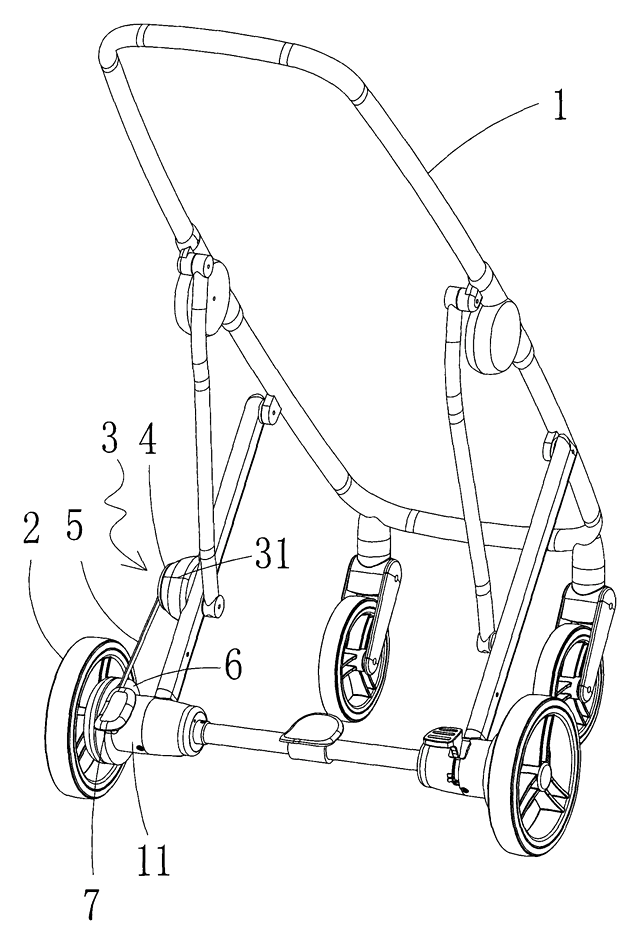
Motorized Rocking Stroller That Rocks by Turning Its Wheels
Baby rocker or stroller whose motor turns the wheels back and forth; a clutch switches to pushing.
Patent CN208119238U
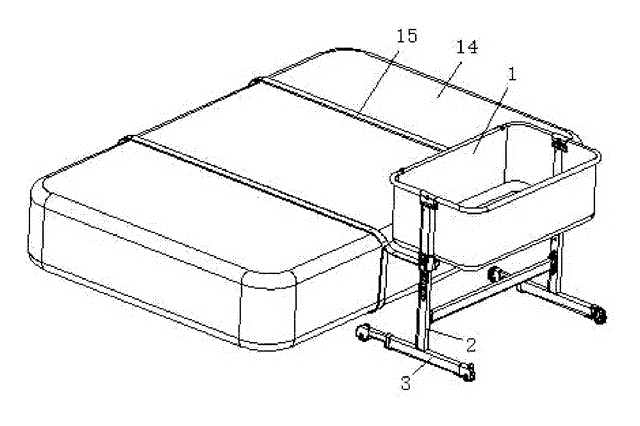
Baby & Kids
Bedside Crib Base with Spring-Loaded Telescoping Caster Legs
Bedside crib feet with spring-loaded sliding casters: wide when alone, short to sit flush at the bed.
Patent CN207168269U
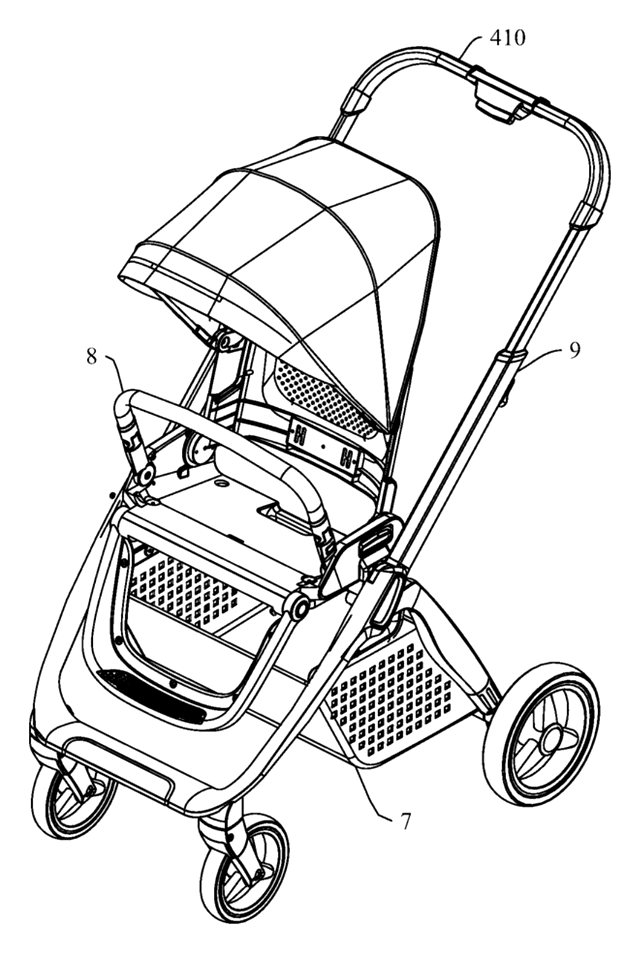
Baby & Kids
Compact-Fold Stroller with a Four-Bar Side Frame and Telescoping Handle
Stroller with four-bar side frames: handle and rear leg fold onto the front leg, handle telescopes.
Patent CN213799844U
Browse by category
- Apparel & Accessories (52)
- Baby & Kids (31)
- Bags & Luggage (18)
- Bath & Personal Care (34)
- Car Accessories (27)
- Furniture, Bedding & Storage (26)
- Garden & Outdoor (34)
- Health & Wellness (15)
- Home, Kitchen & Cleaning (53)
- Lighting (25)
- Packaging & Containers (13)
- Pet Products (12)
- Phone & Camera Accessories (11)
- Retail Display (27)
- School, Office & Art (39)
- Sports & Recreation (50)
- Tools & Workshop (58)
- Toys & Games (24)
This page is based on the public patent document CN215456818U, assigned to Fujian Oubeibi Children's Products Co ltd. IP2M is an independent manufacturing service and is not affiliated with, endorsed by or licensed by the patent owner. Images marked as concept renderings are illustrations, not photos of an existing product. Patent status information is provided for reference only and is not legal advice; confirm freedom to operate for your market before production. Full disclaimer.