
Patent CN106005131B
Updated November 8, 2026Bicycle with Integrated Folding Tent, Umbrella and Rack
Standard bicycles require separate accessories for camping and transport. This design integrates a single folding bracket into the frame geometry. Using a pivot-based support arm and adjustable telescopic legs, the user can reconfigure the bracket's shape. In one state, it holds a shade cloth above the rider; in another, it forms a flat platform over the rear axle; in the third, it stands independently as a shelter frame. The system uses mechanical locks rather than complex electronics, focusing on structural versatility.
- China invention patent - lapsed
- No filings outside China
- Folding bracket mechanism
- Telescopic rods and pin connections
Splat! What let you down?
🏕️
Multi-mode Bracket
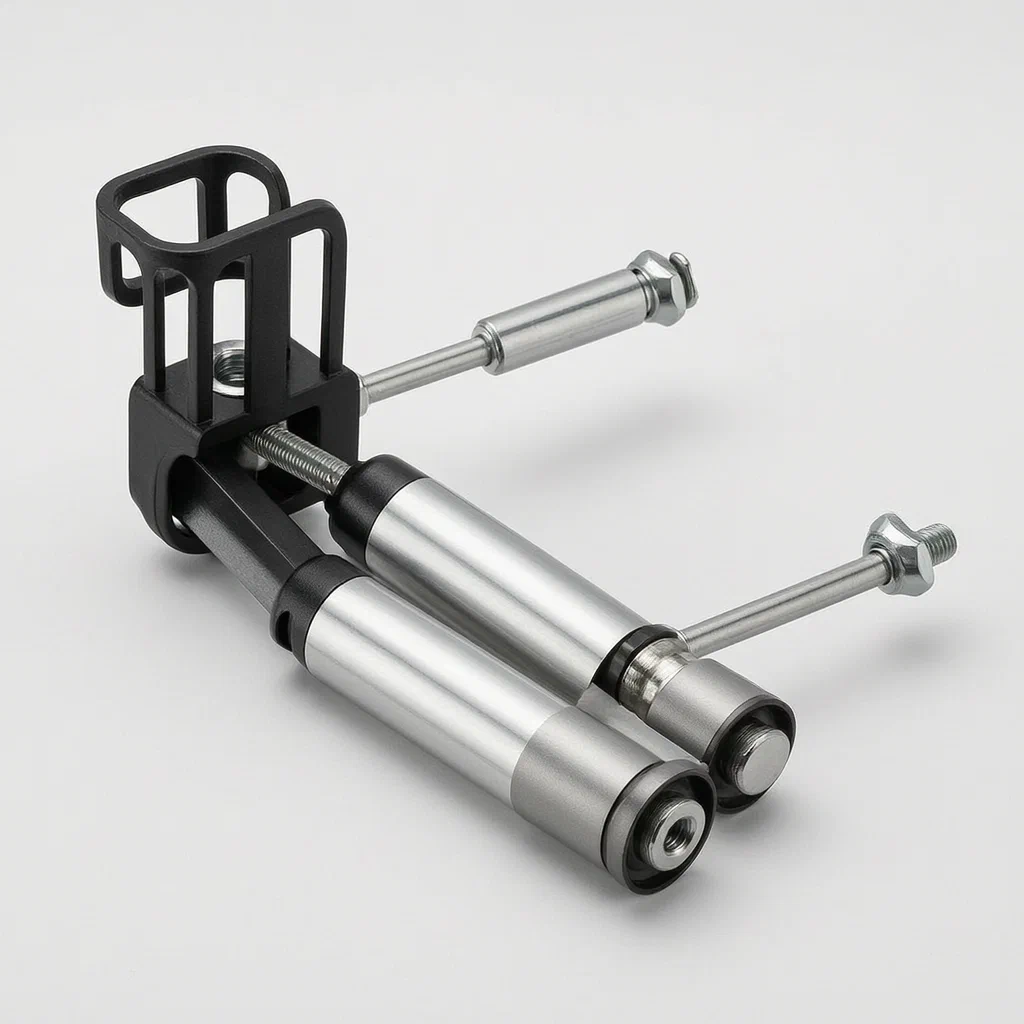
One folding frame converts to an umbrella, cargo rack, or tent structure.
🔩
Pin-Lock Assembly
Support arms use pins and push-cards for quick alignment and locking.
📏
Telescopic Legs
Hollow tube sections extend and lock via thread-and-cone interfaces.
🚲
Frame Integration
Attaches directly to standard bicycle beams using snap-on cages.
Bring this product to market
- ✓ Patent review Patent family and legal status reviewed in the relevant jurisdictions.
- 2 Product brief · now How it works, uses and options written up
- 3 Prototype First samples for buyers to review
- 4 Pilot run Small first batch for launch customers
- 5 Volume production Repeat orders at scale
Buyer interest
– of 100 buyers needed to start prototyping
One click, no sign-up. Each vote is one real visitor, and products with the most interest go to prototyping first.
Build team: no members yet. Need a partner, co-funding or skills to build this? Join and we introduce the team once it forms.
Patent Rights & Team Participation
Before joining a development team, participants should ensure they have the necessary rights or authorization to participate in the project.
Participation is generally appropriate where:
- You own the relevant patent rights or have obtained permission or a license from the rights holder.
- The relevant patent rights have expired or have been legally invalidated in the jurisdictions where the planned activities will take place.
- The planned development, manufacturing, and commercialization activities have been independently assessed and do not infringe applicable patent rights in the relevant jurisdictions.
Important: Being located outside a country where a patent is protected does not automatically exempt you from patent infringement risks. Patent rights may apply based on where development, manufacturing, use, sale, or import activities take place.
IP2M does not grant any patent license or authorization through team participation. Joining a project does not provide permission to use, manufacture, or commercialize patented technology.
The problem
Outdoor cyclists often need to carry multiple bulky items: a sun umbrella for daytime riding, a cargo rack for gear, and a tent for overnight stays. Carrying these separately adds weight and complexity. Existing add-ons are usually fixed-function, meaning a rack cannot become a shelter without being disassembled and rebuilt with different parts. There is a need for a structural solution where the same physical components can be reconfigured to serve these distinct roles efficiently.
The solution
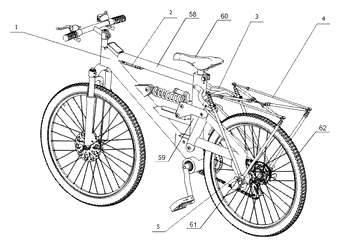
The patent proposes a bicycle frame integrated with a folding bracket (4), a foldable sun umbrella support device (2), and a snap-on cage device (3).
- The support device (2) consists of two rods (41, 42) pinned to the frame beam (58). They rotate to align coaxially and lock together using a push-card (43) and pin (44), forming a rigid vertical post perpendicular to the frame.
- The folding bracket (4) attaches to this post and the frame’s vertical beam (59) via the cage device (3). It uses telescopic pull rods with thread-and-cone locking mechanisms.
- By changing the angle of the vertical swing rod relative to the limit rod, the bracket shifts between states:
- Umbrella Mode: Bracket extends upward, holding a shade cloth above the saddle.
- Rack Mode: Bracket folds down to form a horizontal platform above the rear wheel.
- Tent Mode: Bracket detaches or stands on its base, supporting the shade cloth as a freestanding shelter.
Who it is for
- Outdoor Gear Brands: Companies looking to differentiate bicycle accessories by offering space-saving, multi-functional hardware.
- Campus and Commuter Fleet Operators: Universities or rental services needing bikes that can adapt to weather protection or light cargo without swapping racks.
- Bicycle Manufacturers: OEMs seeking novel frame-integrated features for adventure or touring models.
- DIY Enthusiasts and Repair Shops: Users interested in retrofitting existing frames with modular attachment points for camping setups.
How it works
The main parts
| No. | Part | What it does |
|---|---|---|
| 2 | Support Device | Two rods (41, 42) that pivot and lock into a single vertical column. |
| 3 | Cage Device | Snap-on holder connecting the bracket to the frame’s vertical beam. |
| 4 | Folding Bracket | The main variable-shape frame made of telescopic rods and joints. |
| 41, 42 | Support Rods | Rotate around pins; lock coaxially via push-card (43). |
| 43, 44 | Push Card & Pin | Mechanism to slide and secure the two support rods together. |
| 50 | Cage Support | Connects to bracket legs via snaps and pins. |
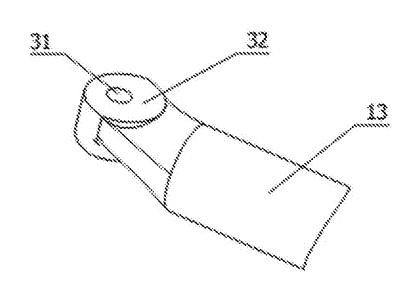
| 37, 38 | Leg Base | Angled feet providing stability when used as a tent. |
Operating Steps
- Deploy Support Post: Rotate rods 41 and 42 until they are coaxial. Slide the push card (43) to insert pin (44) into slot (45), locking them perpendicular to the frame beam.
- Attach Bracket: Mount the folding bracket (4) onto the support post and the cage device (3) on the seat tube/vertical beam (59). Secure with butterfly nuts (5).
- Configure Shape:
- For Umbrella: Extend telescopic rods upward; set vertical swing rod angle to match the complementary angle A+B for standing height. Attach shade cloth.
- For Rack: Fold bracket down; set swing rod to an acute angle to create a flat bed over the rear wheel.
- For Tent: Detach or lower to ground; spread legs so bases (38) sit flat. The fan-shaped limit groove ensures the correct geometry for self-standing.
Applications
Daytime Commuting
In umbrella mode, the shade cloth protects the rider from direct sunlight while cycling in hot climates. The compact design keeps hands free compared to handheld umbrellas.
Weekend Touring
When converting to rack mode, the structure supports panniers or backpacks above the rear wheel. This allows riders to carry extra supplies without installing a permanent heavy-duty rack.
Short-Term Camping
By setting the bracket to tent mode, the same poles and cloth form a small shelter. This is useful for rest stops or lightweight bivouac setups where carrying a separate tent pole kit is unnecessary.
Urban Storage
In its stowed configuration, the devices collapse against the frame. This reduces the overall footprint of the bicycle when parked in tight spaces like elevators or crowded bike racks.
Where it is less suitable
- High-Speed Racing: The added wind resistance and weight of the deployed bracket make it unsuitable for performance road racing.
- Heavy Load Hauling: The telescopic locking mechanism is designed for moderate loads; carrying very heavy industrial cargo may exceed the structural limits of the thin-walled tubes.
- Severe Storms: As a lightweight camping shelter, it lacks the robust anchoring and material strength required for high-wind or heavy-snow environments.
Patent & Production
At a glance
| Patent number | CN106005131B (application CN201610517396) |
| Type | China invention patent - protects method and structure |
| Original title | Bicycle with Three-in-One Function of Camping Tent, Sun Umbrella and Shelf (一种具有野营帐篷、太阳伞和货架三合一功能的自行车) |
| Patent owner | Tianjin University |
| Inventors | Cai Zhijie, Ren Chengzu |
| Filing date | 2016-06-30 |
| Grant date | 2018-07-27 |
| Status (China) | Lapsed - terminated for non-payment of annual fees (recorded 2021-07-02) |
| Patent family | Public record shows Chinese filings only - no US, European, Japanese, PCT or other filings listed |
| Cited by | 0 later documents |
| Source | Google Patents (search for CN106005131B) |
What the claims cover, in plain language
Claim 1 defines a bicycle comprising standard frame elements plus a foldable sun umbrella support device (2), a shade cloth, a snap-on cage device (3), and a folding bracket (4). The support device is pinned to the frame beam. The cage connects to the vertical beam. The claim specifies three operational states for the bracket: (1) unfolded as an umbrella above the saddle, (2) unfolded as a shelf above the rear wheel, and (3) unfolded as a tent on a plane. Connection is achieved via pins and butterfly nuts.
Claim 2 details the support device (2): two rods (41, 42) with pin holes that rotate to become coaxial. A sliding push card (43) inserts a pin (44) into a slot (45) to lock them perpendicular to the frame.
Claim 3 describes the cage device (3): a support rod with symmetrical connecting rods ending in snaps, pin-connected to the frame’s vertical beam.
Claim 4 specifies the folding bracket (4) construction: telescopic hollow tubes with thread-and-cone locking structures. It includes legs with angled bases (angle A < 90°) and joint assemblies with fan-shaped limit grooves to constrain the angles for tent vs. rack configurations.
This is a simplified reading for orientation only. The legal scope is defined by the exact claim wording in the official Chinese document.
What this means for US production
This patent was filed in China and has lapsed due to non-payment of fees, so it no longer restricts anyone in China either. The public record shows no US or other foreign counterpart.
Two points to settle early:
- Other patents may exist. Folding bicycle accessories and multi-functional frame attachments are competitive fields. While this specific combination of a telescopic bracket with a dual-mode support arm is described here, prior art regarding folding racks or bike-mounted shelters may be covered by other active patents in the US. A freedom-to-operate (FTO) review is recommended before mass production.
- Structural Integrity. The design relies on friction locks and threads for load-bearing. Ensuring these do not slip under dynamic bicycle loads requires precise machining and material selection.
Customization and manufacturing
What can be customized
| Area | Options |
|---|---|
| Material | Aluminum extrusion for rods; glass-filled nylon for joints/housings |
| Dimensions | Tube diameter and length to fit specific bicycle frame sizes |
| Finish | Anodized colors for aluminum; matte black for plastic components |
| Locking Mechanism | Thread pitch and cone angle for tighter or looser engagement |
| Fabric | UV-resistant ripstop nylon or polyester for the shade/tent cloth |
| Mounting | Adjustable clamp sizes for the cage device to fit varying seat tube diameters |
Things to plan for (US market)
- CPSC Guidelines: While not a regulated toy, bicycle accessories sold in the US should adhere to general safety guidelines regarding pinch points and sharp edges.
- Load Ratings: No specific federal regulation mandates load ratings for aftermarket racks, but industry standards (e.g., ASTM F1996 for children’s bicycles if applicable, or general ISO standards for adult bikes) guide safe weight limits.
- California Prop 65: Plastics and metal finishes must be screened for listed chemicals.
How a project runs
- Inquiry - Define target bicycle frame compatibility and intended primary use (rack vs. tent).
- Design - Finalize tube diameters, thread specs, and joint geometries based on load requirements.
- Prototype - 3D-printed parts for fit testing; machined aluminum samples for strength verification.
- Pilot Run - Impact tests on joints; cycle testing on the locking mechanism.
- Production - Extrusion cutting, injection molding of connectors, CNC threading, assembly.
Quantities & timeline
Tooling costs depend heavily on the number of unique molds for the complex joint assemblies (three-bar and two-bar connectors). Machining threads on telescopic tubes requires precision. Lead times will vary based on mold creation and surface treatment availability. Send us your target quantity, frame size range, and material preferences and we will reply with options.
Production notes
Tooling and process
Aluminum extrusion is likely used for the main telescopic rods, with the internal and external threads added after extrusion. Injection molding is typically needed for the numerous plastic joints, such as the fan-shaped limit grooves and connector housings. Glass-filled nylon is a common choice for these structural plastics due to its rigidity.
Cost drivers
The number of molds is likely a significant cost driver because the folding bracket contains multiple distinct joint types (three-bar, two-bar, leg bases). Weight also impacts shipping costs for finished goods. Fastener count influences assembly time and labor costs.
Prototyping path
Initial functional samples typically use 3D-printed parts to verify the geometric locking angles. Machined frame prototypes allow for real-world stress testing of the thread-and-cone interfaces before committing to tooling.
What we would change before tooling
We might adjust the wall thickness of the telescopic tubes to optimize strength-to-weight ratio. The hinge boss design could be reinforced to prevent cracking under impact during rapid folding/unfolding cycles.
Common failure points
Bolts loosening due to vibration is a likely risk; thread engagement torque must be specified carefully. UV degradation of the fabric and plastic joints is expected over time. Cracking under impact at the connection points is a potential failure mode if the plastic grade is insufficient.
Patent drawings
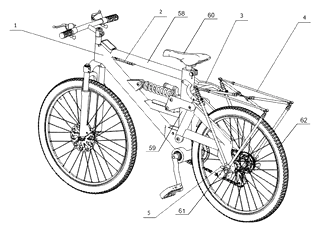
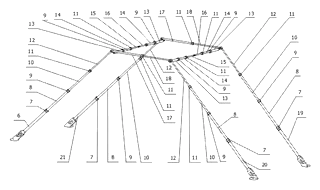
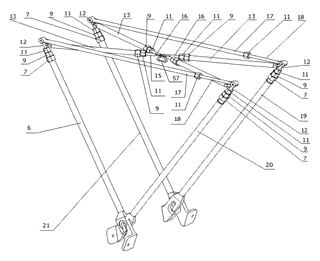
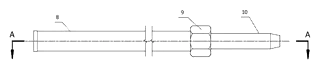
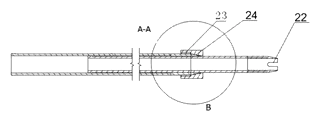
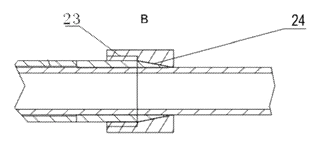
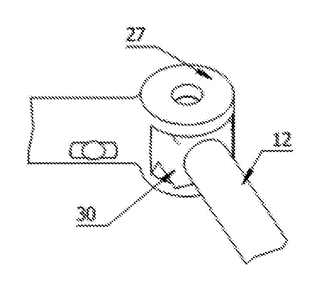
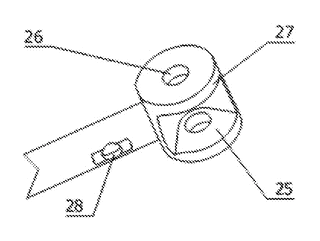
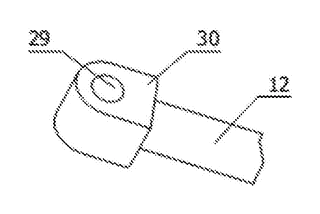
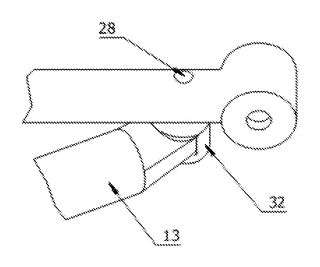
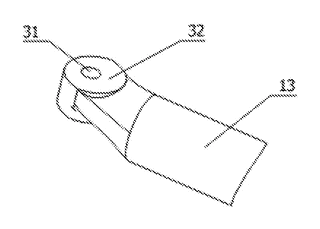
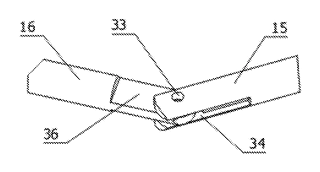
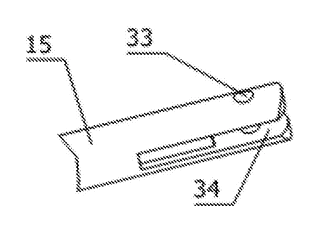
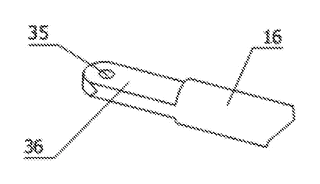
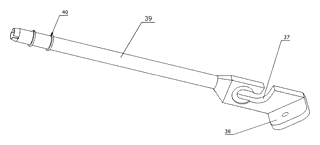
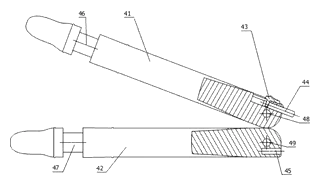
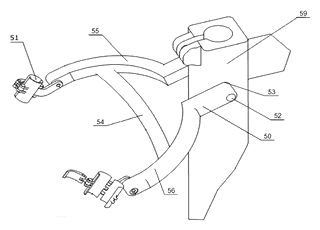
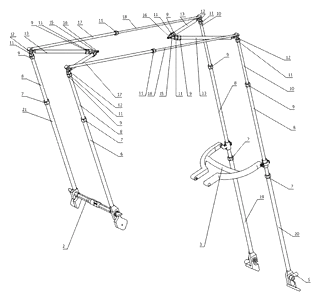
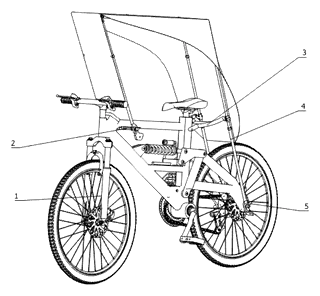
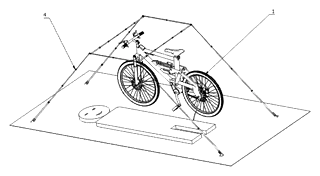
Drawings reproduced from the public patent document for reference.
Frequently asked questions
How does the bracket switch from a rack to a tent?
The folding bracket uses telescopic rods and joints with fan-shaped limit grooves. To switch modes, you unlock the joints, adjust the angle of the vertical swing rod, and lock it again. For a rack, the angle is acute to keep it flat over the wheel. For a tent, the angle opens wider so the legs stand on the ground.
Is the umbrella function stable while riding?
The support device locks the two rods into a single rigid column using a pin and push-card mechanism. However, the patent does not specify wind-load ratings. Stability depends on the final material choice and the tightness of the thread-and-cone locks.
Can I install this on any bicycle?
It is designed for frames with a standard top tube (beam 58) and seat tube (vertical beam 59). The cage device uses pins and snaps, so it fits most adult commuter or touring frames, but custom clamps may be needed for unusual geometries.
What materials are used?
The patent mentions telescopic hollow tubes and locking structures. Typically, these would be aluminum extrusion for the tubes and glass-filled nylon or similar engineering plastics for the joints and housing to balance weight and strength.
Does it come with the tent fabric?
The patent includes a “shade cloth” as part of the system. The cloth is attached to the bracket. Specific fabric types (nylon, polyester) and waterproofing levels are determined in the product design phase.
How much weight can the rack hold?
The patent does not provide a specific load rating. Capacity is limited by the strength of the telescopic tubes and the locking threads. Designers typically set this for light to medium loads (e.g., 10-20 kg) and confirm via prototype testing.
Can this design be made and sold in the US?
The patent was filed in China and has lapsed due to non-payment of fees. The public record shows no US counterpart, so it does not restrict the design in the US. However, other patents covering folding bike accessories may exist, so a freedom-to-operate check is advised.
Are you affiliated with the patent owner?
No. IP2M is an independent design and manufacturing service working from the public patent document.
Request a quote
Click Request a Quote below to see our email address - copy it, or open your email app with a ready-made message. Please mention patent CN106005131B in the subject.
Helpful details to include:
- Your company and channel (bike brand, outdoor gear retailer, university fleet manager)
- Target frame sizes and compatibility requirements
- Preferred materials (aluminum grade, plastic type)
- Desired finish (anodized color, powder coat)
- Estimated quantity and target price
- Timeline - when you would like samples and the first shipment
You can also reach us at (332) 203-9997.
Page editor: Daniel Chen, Product Research Editor · IP2M
Last updated November 8, 2026. If something on this page looks wrong, email [email protected] and we will check it against the patent.
Interested in building this?
Tell us your target market, quantity and timeline. We reply with options for prototyping, small-batch runs or volume production.
Send your inquiry to
Please put CN106005131B in the subject line and tell us your company, country, estimated quantity and timeline.
Prefer to talk? Call (332) 203-9997.
More product-ready patents
All Sports & Recreation patents →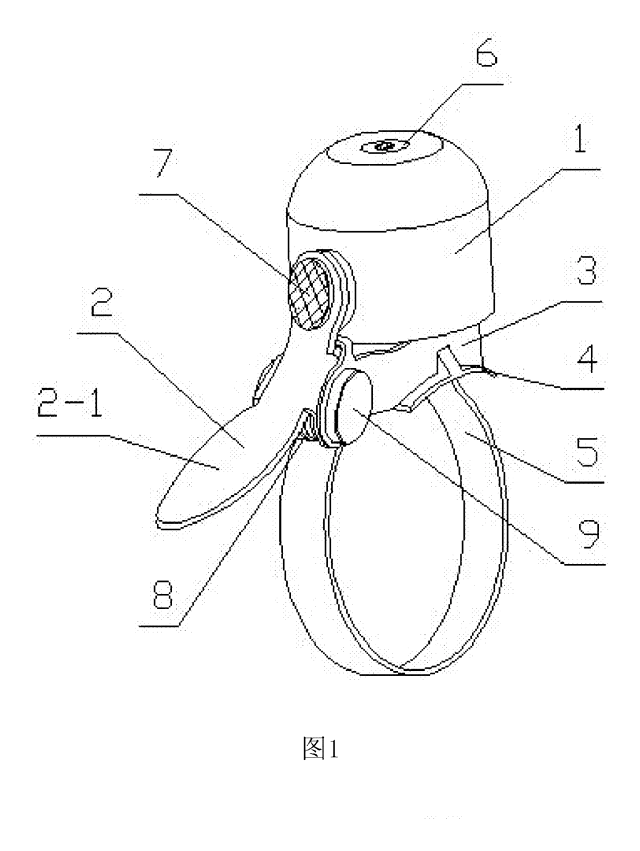
Sports & Recreation
Compact Torsion-Spring Bike Bell
Mini bike bell with a standard torsion spring and a rubber-floated dome - small size, clear tone, quick strap mount.
Patent CN205819384U
Sports & Recreation
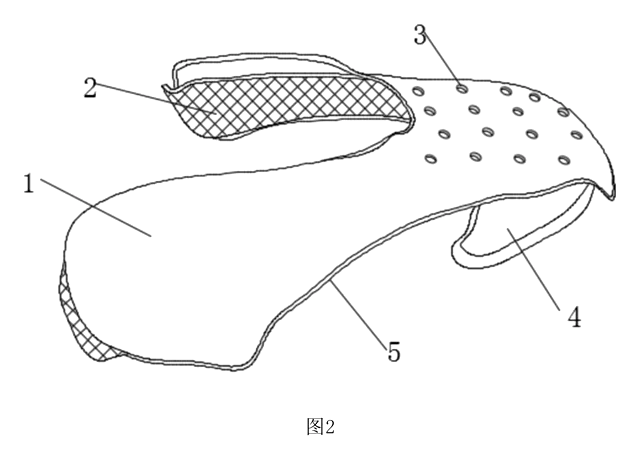
Padded Toe-Box Shield for Sneakers
Ventilated, silicone-lined toe-box insert that supports the front of a sneaker and cushions the toes.
Patent CN209473731U
Sports & Recreation
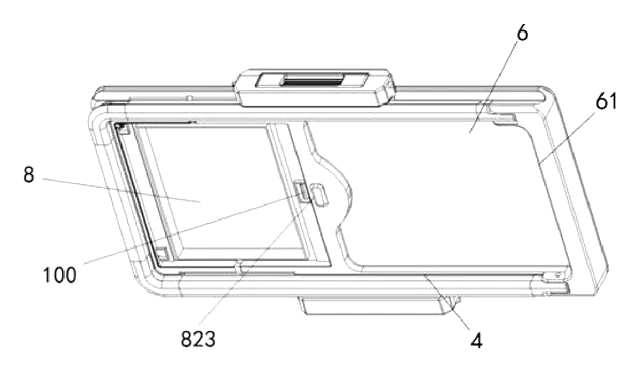
Reversible Fishing Seat-Box Lid with Backrest
Fishing seat-box lid that flips on removable hinge pins: cushion, backrest and storage on one face.
Patent CN208624426U
Sports & Recreation
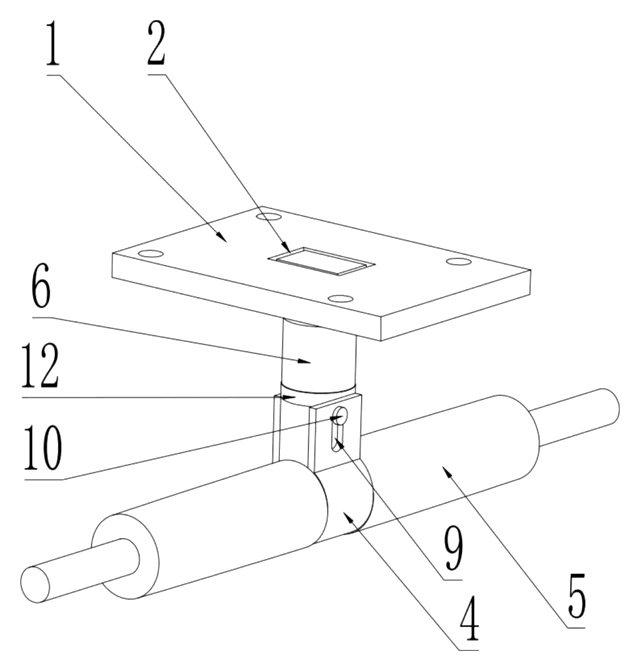
Swivel-Pin Skateboard Truck with Rubber Sleeve
Skateboard truck with a turning center pin, a tilting axle clamp and a rubber sleeve that centers it.
Patent CN216777880U
Sports & Recreation
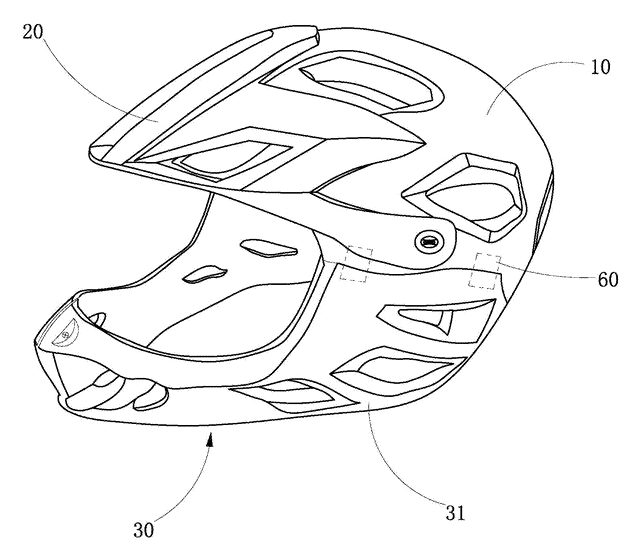
Full-Face Bike Helmet with Magnetic Detachable Chin Bar
Full-face cycling helmet whose chin bar clips on and off with magnetic, latching side connectors.
Patent CN206630067U
Sports & Recreation
Bike Phone Holder with Built-In Flashlight Clamp
Handlebar mount with a phone cradle on top and a flashlight clamp below, on one arm.
Patent CN206077485U
Browse by category
- Apparel & Accessories (52)
- Baby & Kids (31)
- Bags & Luggage (18)
- Bath & Personal Care (34)
- Car Accessories (27)
- Furniture, Bedding & Storage (26)
- Garden & Outdoor (34)
- Health & Wellness (15)
- Home, Kitchen & Cleaning (53)
- Lighting (25)
- Packaging & Containers (13)
- Pet Products (12)
- Phone & Camera Accessories (11)
- Retail Display (27)
- School, Office & Art (39)
- Sports & Recreation (50)
- Tools & Workshop (58)
- Toys & Games (24)
This page is based on the public patent document CN106005131B, assigned to Tianjin University. IP2M is an independent manufacturing service and is not affiliated with, endorsed by or licensed by the patent owner. Images marked as concept renderings are illustrations, not photos of an existing product. Patent status information is provided for reference only and is not legal advice; confirm freedom to operate for your market before production. Full disclaimer.