
Patent CN110720723B
Updated November 8, 2026Luggage with Retractable Wheels and Gear-Locked Handle
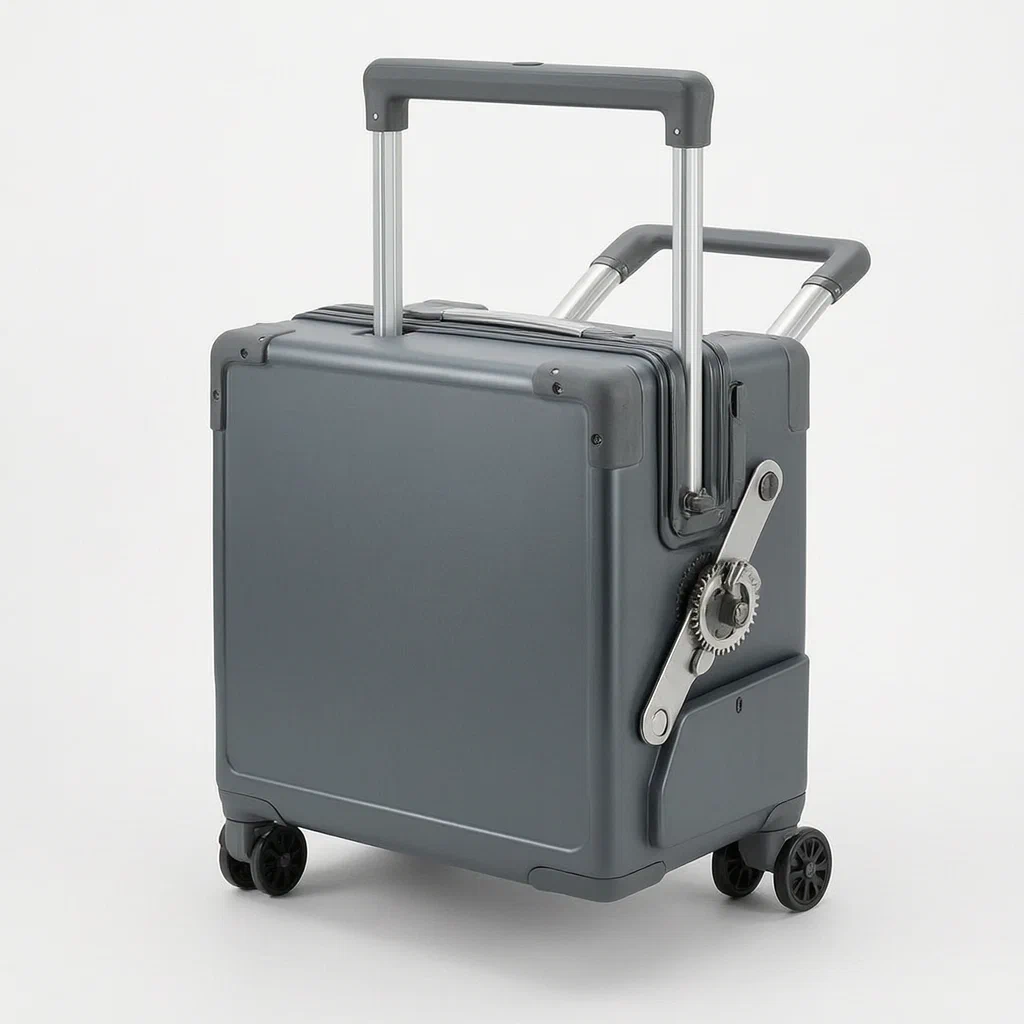
Standard suitcases wobble when stacked because their wheels stick out. This patent describes a hard-shell case where the act of lowering the handle automatically pulls the wheels into a recessed bottom cavity. A gear and rack mechanism links the telescopic rods to the wheel arms. Once lowered, the case sits perfectly flat for secure stacking in overhead bins or shelves. When raised for pulling, the wheels deploy, and a secondary lock prevents ground pressure from retracting them mid-trip. Spring-loaded dampers absorb shock from rough pavement, reducing stress on the axle connections.
- China invention patent - in force
- No filings outside China
- Gear-linked wheel retraction
- Shock-absorbing wheel mount
Splat! What let you down?
🔄
Handle-Linked Retraction
Lowering the telescopic handle automatically drives the wheels into a bottom storage cavity.
📦
Flat Stacking Stability
With wheels retracted, the case rests flush on its base, preventing tipping when stacked.
🔒
Anti-Retraction Lock
A clamping block and control rod prevent ground pressure from accidentally lifting the wheels during use.
🛡️
Vibration Buffering
Internal springs isolate the wheel assembly from shocks on uneven surfaces, reducing structural stress.
Bring this product to market
- ✓ Patent review Patent family and legal status reviewed in the relevant jurisdictions.
- 2 Product brief · now How it works, uses and options written up
- 3 Prototype First samples for buyers to review
- 4 Pilot run Small first batch for launch customers
- 5 Volume production Repeat orders at scale
Buyer interest
– of 100 buyers needed to start prototyping
One click, no sign-up. Each vote is one real visitor, and products with the most interest go to prototyping first.
Build team: no members yet. Need a partner, co-funding or skills to build this? Join and we introduce the team once it forms.
Patent Rights & Team Participation
Before joining a development team, participants should ensure they have the necessary rights or authorization to participate in the project.
Participation is generally appropriate where:
- You own the relevant patent rights or have obtained permission or a license from the rights holder.
- The relevant patent rights have expired or have been legally invalidated in the jurisdictions where the planned activities will take place.
- The planned development, manufacturing, and commercialization activities have been independently assessed and do not infringe applicable patent rights in the relevant jurisdictions.
Important: Being located outside a country where a patent is protected does not automatically exempt you from patent infringement risks. Patent rights may apply based on where development, manufacturing, use, sale, or import activities take place.
IP2M does not grant any patent license or authorization through team participation. Joining a project does not provide permission to use, manufacture, or commercialize patented technology.
The problem
Traditional rolling suitcases suffer from two main issues regarding storage and durability. First, when placed vertically on a shelf or stacked in an airplane overhead bin, the protruding caster wheels create an unstable base, causing the luggage to tip over easily. Second, the direct connection between the wheels and the shell means that every bump on rough pavement transfers significant vibration and stress to the mounting points, leading to premature wear or detachment of the wheel assemblies. Existing solutions often require manual intervention to stow wheels or add bulky external covers, which defeats the purpose of sleek, modern luggage design.
The solution
This patent introduces a mechanical linkage system integrated directly into the suitcase structure. The solution relies on the existing motion of the telescopic handle to control the position of the wheels.
- Telescopic Handle Integration: The primary handle consists of a fixed rod and two stages of telescopic rods. The first-stage telescopic rod features teeth along its side.
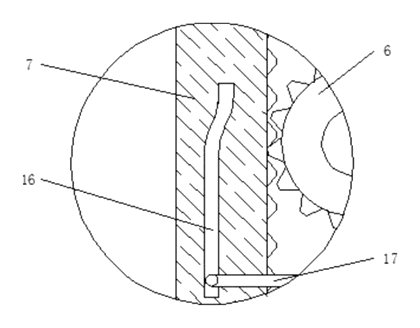
- Gear and Rack Drive: These teeth mesh with a gear located inside the box body. This gear engages with a vertical rack. As the handle is lowered, the rotation of the gear pushes the rack upward.
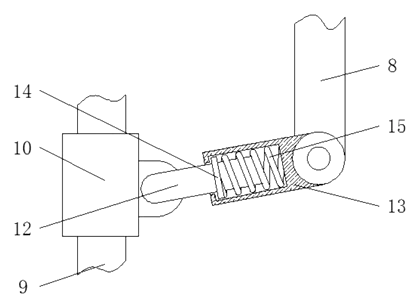
- Wheel Arm Actuation: The top of the rack is connected to a sliding rod. This rod interacts with a sleeve on a movable rod that holds the wheel. As the rack moves up, it forces the movable rod to rotate around its pivot point, swinging the wheel inward into a recessed cavity at the bottom of the suitcase.
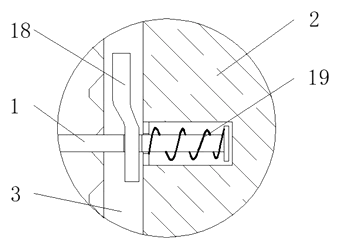
- Locking Mechanism: To ensure the wheels stay down when pulled, a control rod and clamping block interact with the rack. When the handle is extended, the clamping block moves the rack away from the gear, disengaging the retraction drive so that upward pressure from the ground does not accidentally retract the wheels.
- Shock Absorption: The wheel assembly includes a connecting rod linked to a sliding block and an elastic spring housed within a cavity. This spring absorbs vibrations from the movable rod before they reach the rigid frame of the suitcase body.
Who it is for
- Airline and Travel Brands: Companies selling premium cabin bags where stacking stability in overhead bins is a key selling point.
- Retail Luggage Chains: Stores looking for differentiated products that offer unique mechanical features compared to standard spinner cases.
- Wholesale Distributors: Buyers seeking durable designs with built-in shock absorption to reduce return rates due to broken wheel mounts.
- OEM Manufacturers: Factories capable of precision injection molding and metal stamping who want to implement complex mechanical linkages in hard-shell cases.
How it works
The main parts
The mechanism is compactly arranged within the lower section of the suitcase shell.
| No. | Part | What it does |
|---|---|---|
| 1 | Box Body | The main suitcase shell containing the mechanism cavity. |
| 2 | Fixed Rod | The stationary part of the handle assembly attached to the body. |
| 3 | First-Level Telescopic Rod | Extends/contracts; has teeth that drive the gear. |
| 4 | Second-Level Telescopic Rod | The inner handle segment; shorter than the first level. |
| 5 | Handle | The grip at the top, featuring a release button. |
| 6 | Gear | Meshes with the rod teeth and the rack; converts linear handle motion to rack motion. |
| 7 | Rack | Moves vertically; connected to the wheel actuation arm. |
| 8 | Sliding Rod | Connects the rack to the wheel pivot mechanism. |
| 9 | Movable Rod | The arm that holds the wheel; rotates to retract/deploy. |
| 11 | Movable Wheel | The caster; swings into the bottom cavity when retracted. |
| 15 | Elastic Spring | Buffers vibration between the wheel arm and the body. |
| 17 | Control Rod | Slides horizontally to engage/disengage the locking mechanism. |
| 18 | Clamping Block | Attached to the telescopic rod; pushes the control rod to lock/unlock. |
Operating steps
- Deploying for Travel: The user presses the button on the handle and pulls the telescopic rods up. As the first-level rod rises, its teeth rotate the gear. The gear drives the rack downward. The sliding rod follows, rotating the movable rod outward, bringing the wheel into contact with the ground. Simultaneously, the clamping block moves the control rod to disengage the rack from the gear’s driving force, locking the wheels in the deployed position against ground pressure.
- Stowing for Storage: The user presses the button and pushes the handle down. The first-level rod descends, rotating the gear in reverse. The gear drives the rack upward. The sliding rod pulls the movable rod inward, swinging the wheel into the recessed cavity at the bottom of the box.
- Stacking: With the wheels fully retracted into the cavity, the bottom surface of the suitcase is flat. It can be stacked securely on top of another unit or placed upright on a shelf without wobbling.
- Shock Absorption: While being pulled over uneven surfaces, the wheel hits bumps. The force travels through the movable rod and connecting rod. The elastic spring compresses, absorbing the impact energy and preventing excessive stress on the connection points between the wheel assembly and the box body.
Applications
Airplane Overhead Bins
When packed tightly in overhead compartments, standard suitcases with exposed wheels slide off each other. This design allows cases to stack flush, maximizing space utilization and reducing the risk of items falling onto passengers.
Retail Display and Warehousing
Brands displaying luggage in showrooms or warehouses benefit from the stable stacking capability. Products can be piled vertically without additional shelving supports, saving floor space and presenting a clean, uniform look since no wheels protrude.
Rough Terrain Travel
For travelers navigating cobblestone streets or airport tarmac joints, the integrated spring buffering reduces the transmission of high-frequency vibrations to the frame. This helps maintain the integrity of the wheel mounts over repeated trips.
Compact Home Storage
Users storing luggage in closets or under beds prefer units that do not have awkward protrusions. The retracted wheel profile makes the suitcase rectangular and easier to fit into tight storage spaces alongside other household items.
Where it is less suitable
- Ultra-lightweight Soft-Sided Bags: The rigid internal cavity required for the gear and rack mechanism adds weight and complexity, making it unsuitable for minimalist soft-shell duffels.
- Extreme Heavy-Duty Industrial Cases: The intricate linkage may be prone to failure under extreme loads beyond standard consumer travel weights; simpler bolt-on casters are preferred for rugged industrial use.
- Low-Cost Mass Market: The additional parts (gears, racks, springs, control rods) increase manufacturing complexity and cost compared to basic molded plastic wheel housings.
Patent & Production
At a glance
| Patent number | CN110720723B (application CN201911041847) |
| Type | China invention patent (发明专利) - protects product structure and method |
| Original title | A difficult-to-damage, easy-to-place and pleasing-to-the-eye suitcase (一种不易损坏便于放置且美观的行李箱) |
| Patent owner | Hunan Sunshine luggage Co., Ltd |
| Inventors | Li Zhongjuan |
| Filing date | 2019-10-30 |
| Grant date | 2021-08-13 |
| Status (China) | In force - valid until at most 2039-10-30, provided annual fees are paid |
| Patent family | Public record shows Chinese filings only - no US, European, Japanese, PCT or other filings listed |
| Cited by | 3 later documents |
| Source | Google Patents (search for CN110720723B) |
What the claims cover, in plain language
Claim 1 - defines a suitcase comprising a box body, a telescopic handle assembly (fixed rod, first-level and second-level telescopic rods), and a wheel retraction mechanism. The key feature is a gear mounted in the box body that meshes with teeth on the first-level telescopic rod and a rack. The rack is connected via a sliding rod to a movable rod holding the wheel. Lowering the handle drives the rack upward, rotating the movable rod to retract the wheel into a containing cavity at the bottom of the box. The claim further specifies a locking mechanism involving a control rod and clamping block that disengages the rack from the gear when the handle is extended, preventing accidental retraction. It also includes an elastic spring between the connecting rod and the body to buffer vibrations.
This is a simplified reading for orientation only. The legal scope is defined by the exact claim wording in the official Chinese document.
What this means for US production
This patent was filed in China and is currently in force there. The public record shows no US or other foreign counterpart. Therefore, making or selling this specific design in the United States is not restricted by this Chinese patent. However, because the patent is active in China, manufacturing the product in China requires permission from the patent owner.
Two points to settle early:
- Other patents may exist. Luggage mechanisms are a crowded field. Notably, Sharkninja Operating LLC holds several US design patents (USD1140653S1, USD1141735S1) that cite this technology, indicating potential overlap in visual or functional aspects. A freedom-to-operate (FTO) review is strongly recommended to check for conflicting utility patents in the US regarding gear-driven retraction systems.
- Mechanical Complexity. The integration of gears, racks, and locking rods inside a thin-walled suitcase shell presents significant tolerance challenges. Ensuring smooth operation without jamming requires precise alignment of moving parts.
Customization and manufacturing
What can be customized
| Area | Options |
|---|---|
| Shell Material | PC, ABS, or PP depending on flexibility needs for the cavity |
| Gear/Rack Material | POM or Nylon for low friction and noise reduction |
| Spring Rate | Adjustable stiffness based on expected load and terrain |
| Handle Height | Standard 2-stage or 3-stage telescopic configurations |
| Wheel Size | 50mm to 75mm casters compatible with the retraction radius |
| Finish | Matte, glossy, or textured exterior coatings |
Things to plan for (US market)
- CPSC Safety Standards: Ensure no pinch points in the mechanism that could injure users during handle extension/retraction.
- ASTM F963 / CPSIA: If targeting children’s luggage, strict lead and phthalate limits apply to plastics and paints.
- Battery Compliance: If adding smart features (not described here but common in market), UN 38.3 applies. For this purely mechanical design, focus on structural integrity tests.
- Proposition 65: California requirements for labeling chemicals in plastics and metals used in the mechanism.
How a project runs
- Design Review: Analyze CAD models for interference between the gear train and shell walls.
- Tooling Design: Create molds for the shell cavity and precision dies for metal rods.
- Prototyping: Assemble functional samples using 3D-printed hardware to test the linkage ratio.
- Testing: Cycle testing for the retraction mechanism (e.g., 5000+ open/close cycles) and drop tests.
- Production: Injection molding shells, assembling internal mechanics, attaching handles, and final QC.
Quantities & timeline
The custom cavity in the shell requires specialized injection molds with slides or lifters to form the recesses for the gears and rack. Metal components like the control rod and clamping block need stamping or machining. Assembly is labor-intensive due to the multiple small moving parts. Certification testing for stability and durability takes time. Send us your target shell material, wheel size, quantity, and desired retail price point and we will reply with options.
Production notes
Tooling and process
Molded hardware is critical for the gear and rack components to ensure consistent tooth profiles. The suitcase shell requires a mold with complex core/cavity inserts to form the internal containment chamber for the mechanism. Aluminum frame elements may be used for the telescopic rods if higher rigidity is needed, though steel is common.
Cost drivers
Hardware costs likely dominate due to the precision requirements of the gear-rack interface. Shell material selection impacts the ability to hold threads for mounting the internal mechanism. Packaging must protect the delicate protruding handle rods during shipping.
Prototyping path
We would typically start with sewn first samples if using fabric panels, but this design is primarily hard-shell. Use 3D-printed or machined hardware for the initial linkage to verify the kinematic geometry. Perform wheel and handle test iterations to tune the spring rate before committing to tooling.
What we would change before tooling
We would likely verify the clearance between the rack and the sliding cavity to prevent binding. Optimize the gear ratio to ensure the handle force required to retract the wheels is manageable for all users. Confirm the locking mechanism engagement angle to avoid accidental disengagement.
Common failure points
Shaft and bearing alignment is the highest risk; misalignment causes grinding or jamming. Spring fatigue and rate consistency affect the shock absorption performance over time. Handle detachment can occur if the screw bosses in the shell crack under tension. Frame distortion may warp the guide paths for the telescopic rods.
Patent drawings
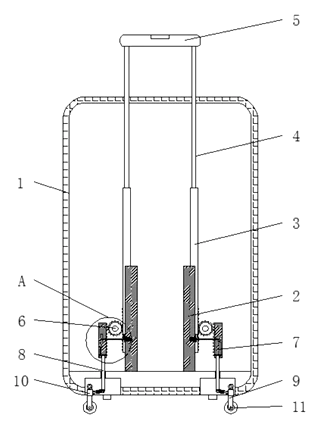
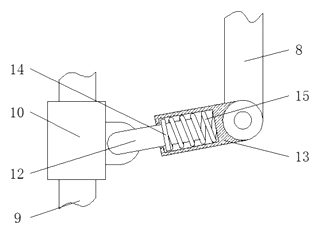
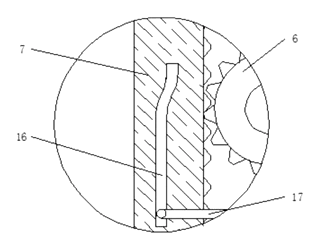
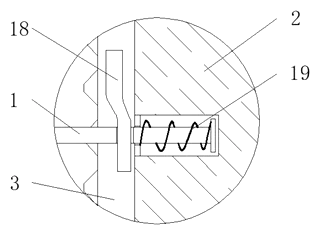
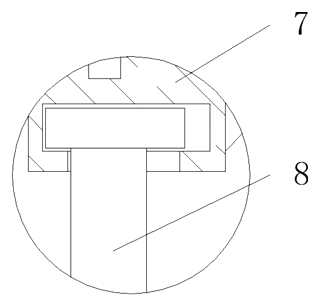
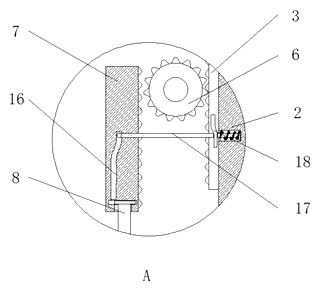
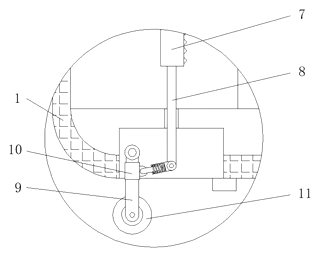
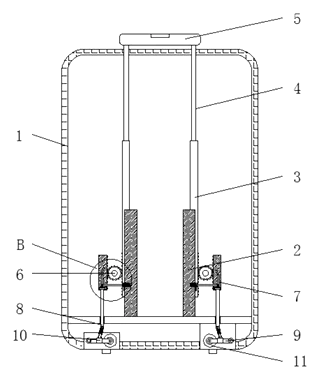
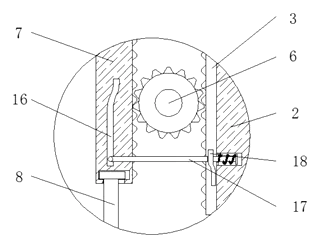
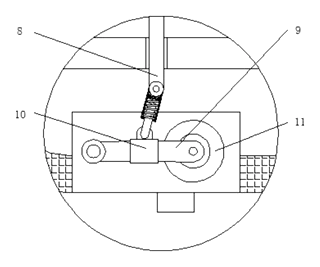
Drawings reproduced from the public patent document for reference.
Frequently asked questions
How do the wheels retract?
You don’t touch the wheels. When you push the telescopic handle down to store the suitcase, the internal gears convert that downward motion into an upward pull on a rack. This rack rotates the wheel arms, swinging the casters into a hidden cavity at the bottom of the shell.
Why is this better for stacking?
Standard suitcases have wheels sticking out, making them round and unstable on top of other bags. With the wheels tucked inside, the bottom of this suitcase is completely flat. This creates a stable platform for stacking in overhead bins or on shelves, reducing the chance of tipping.
Do the wheels stay down when I pull the bag?
Yes. The design includes a locking mechanism. When the handle is extended for travel, a control rod shifts to disconnect the drive gear from the rack. This ensures that the upward force from the ground doesn’t accidentally push the wheels back up while you are walking.
Is the mechanism fragile?
The patent includes an elastic spring system specifically to buffer vibrations. When you roll over bumps, the spring absorbs the shock before it reaches the rigid frame. This protects the connection points and extends the life of the wheel assembly compared to rigid-mounted casters.
Can I customize the wheel size?
Yes, but the retraction cavity dimensions must match the wheel diameter and swing radius. Larger wheels require deeper cavities, which might impact the interior packing volume. We can adjust the linkage ratios to accommodate different wheel sizes.
Does this work with soft-sided luggage?
No. The mechanism requires a rigid internal structure to house the gears, racks, and sliding cavities. This design is intended for hard-shell suitcases made of materials like PC or ABS.
Can this design be made and sold in the US?
The patent is in force in China, but the public record shows no US counterpart. This means you can manufacture and sell this design in the US without infringing this specific Chinese patent. However, we recommend a freedom-to-operate check, as other companies (like Sharkninja) have cited this technology in their own US design patents.
Are you affiliated with the patent owner?
No. IP2M is an independent design and manufacturing service working from the public patent document.
Request a quote
Click Request a Quote below to see our email address - copy it, or open your email app with a ready-made message. Please mention patent CN110720723B in the subject.
Helpful details to include:
- Your company and channel (travel brand, retailer, distributor)
- Target shell material (PC, ABS, PP)
- Wheel specifications (size, color, spinners vs. inline)
- Handle configuration (number of stages, height range)
- Estimated quantity and target price
- Timeline - when you would like samples and the first shipment
You can also reach us at (332) 203-9997.
Page editor: Emily Zhang, Product Editor · IP2M
Last updated November 8, 2026. If something on this page looks wrong, email [email protected] and we will check it against the patent.
Interested in building this?
Tell us your target market, quantity and timeline. We reply with options for prototyping, small-batch runs or volume production.
Send your inquiry to
Please put CN110720723B in the subject line and tell us your company, country, estimated quantity and timeline.
Prefer to talk? Call (332) 203-9997.
More product-ready patents
All Bags & Luggage patents →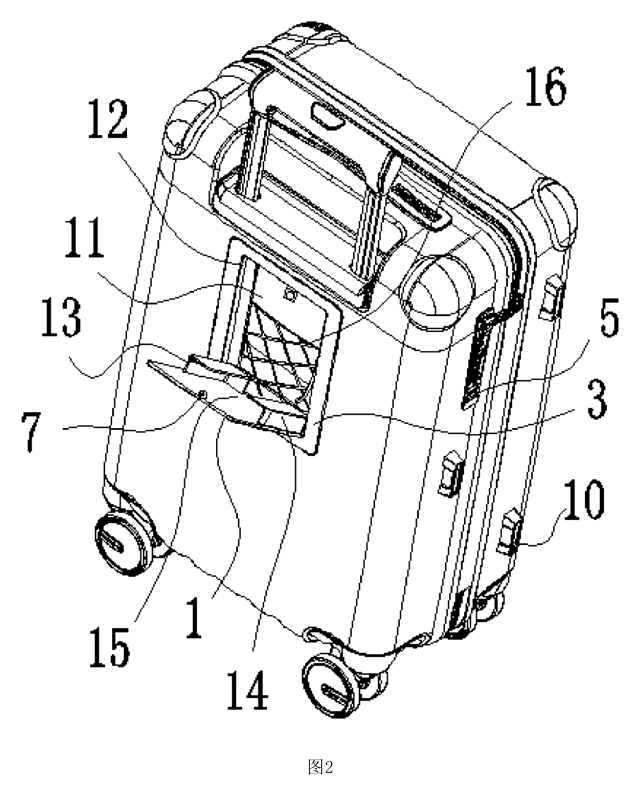
Bags & Luggage
Quick-Access Luggage with Fold-Down Back Compartment
Hard-shell suitcase with a fold-down compartment in the back panel for phone, passport and power bank - no need to open the case.
Patent CN210076793U
Bags & Luggage
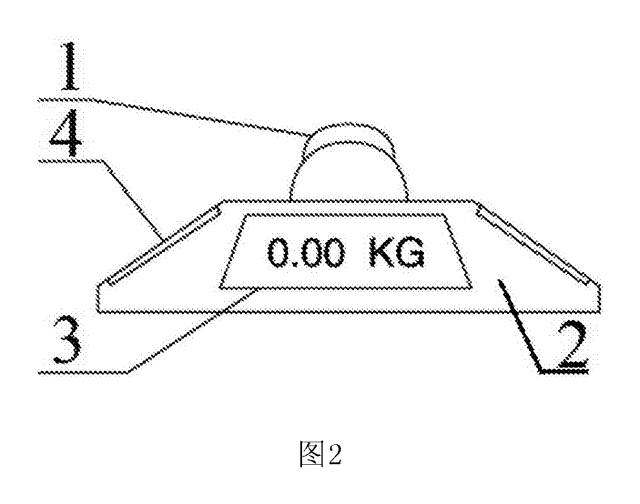
Luggage Handle with Built-In Scale
Suitcase carry handle with a built-in weighing sensor and display - lift the bag and read its weight.
Patent CN206670777U
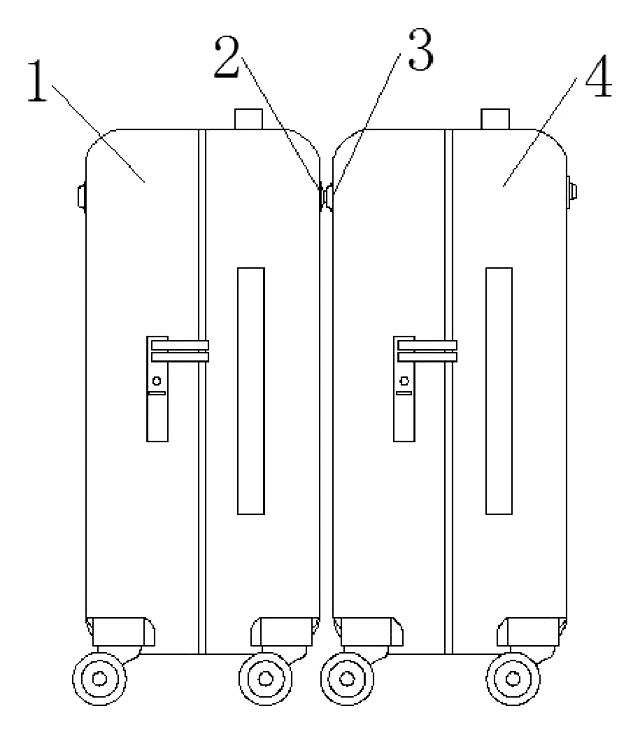
Bags & Luggage
Snap-Together Luggage Connector
Stud-and-socket snap built into suitcases so two cases lock together and roll with one hand.
Patent CN209862619U
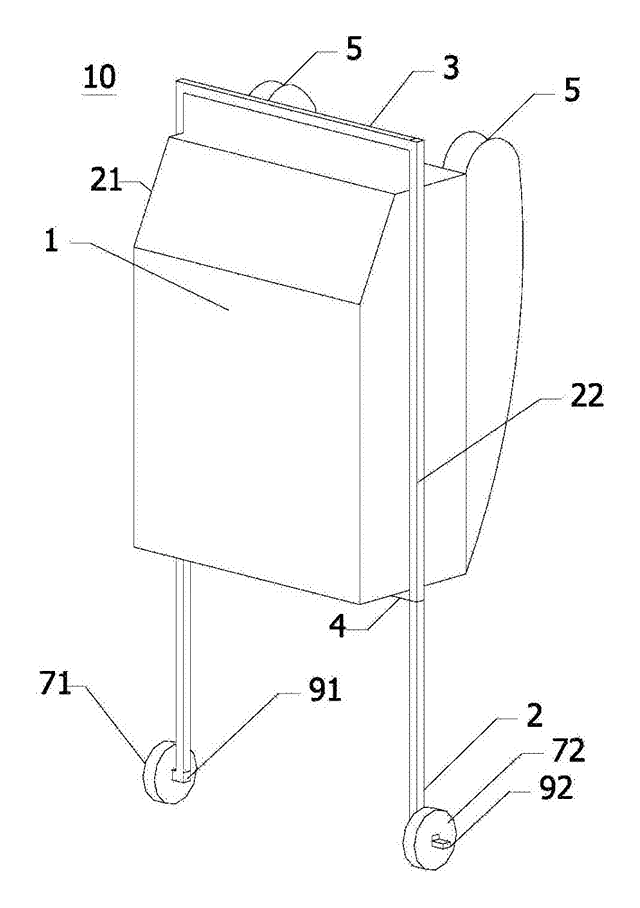
Bags & Luggage
Side-Rail Rolling Backpack with Raised Wheels
Rolling backpack with pull rails on the sides, not the back, and rails that lower the wheels.
Patent CN207733803U
Bags & Luggage
Backpack with Removable Body-Shaped Inner Frame
Backpack with a lift-out inner frame shaped to the back that spreads the load to the back and hips.
Patent CN216534262U
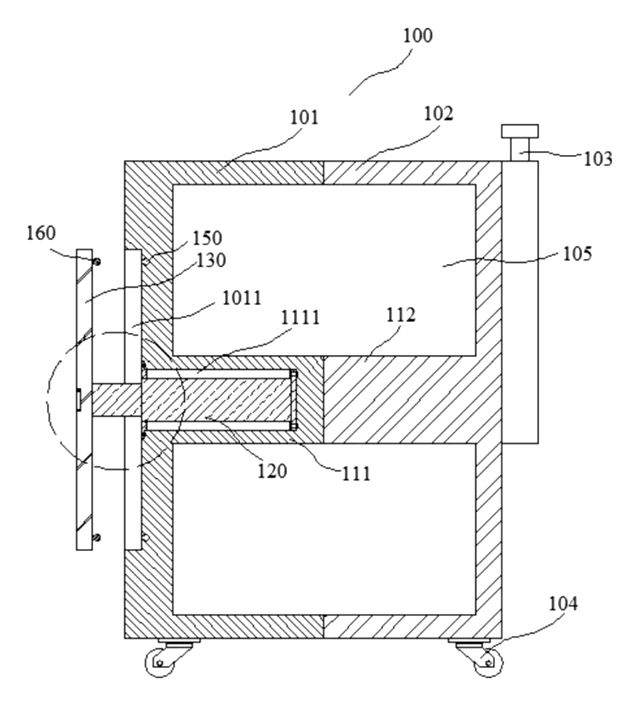
Bags & Luggage
Hard-Shell Luggage Case with a Built-In Lift Table
Hard-shell luggage with a telescopic rod and desktop that rises from the lid.
Patent CN107485137B
Browse by category
- Apparel & Accessories (52)
- Baby & Kids (31)
- Bags & Luggage (18)
- Bath & Personal Care (34)
- Car Accessories (27)
- Furniture, Bedding & Storage (26)
- Garden & Outdoor (34)
- Health & Wellness (15)
- Home, Kitchen & Cleaning (53)
- Lighting (25)
- Packaging & Containers (13)
- Pet Products (12)
- Phone & Camera Accessories (11)
- Retail Display (27)
- School, Office & Art (39)
- Sports & Recreation (50)
- Tools & Workshop (58)
- Toys & Games (24)
This page is based on the public patent document CN110720723B, assigned to Hunan Sunshine luggage Co., Ltd. IP2M is an independent manufacturing service and is not affiliated with, endorsed by or licensed by the patent owner. Images marked as concept renderings are illustrations, not photos of an existing product. Patent status information is provided for reference only and is not legal advice; confirm freedom to operate for your market before production. Full disclaimer.